A Complete Guide to Sakazutsuyaki | History and Characteristics of a Traditional Ceramic Production Area in Kurashiki, Okayama Prefecture
Okayama Prefecture is known as a famous ceramic production area for Bizen ware, but in Kurashiki City, there is a traditional ceramic production area called “Sakazutsuyaki (酒津焼)” that possesses charms different from Bizen ware. Sakazutsuyaki, founded in Meiji 2 (1869), boasts a history of over 150 years as the oldest pottery currently existing within Kurashiki City.
This article provides a comprehensive explanation of Sakazutsuyaki’s historical background, technical characteristics, comparisons with other ceramic production areas in Okayama Prefecture, and the positioning of Sakazutsuyaki in contemporary times.
What is Sakazutsuyaki | Kurashiki’s Oldest Ceramic Production Area
Sakazutsuyaki is pottery fired in the Sakazutsu district of Kurashiki City, Okayama Prefecture. It is said that the history began when Suekichi Okamoto, a wealthy merchant of Kurashiki, took notice of high-quality pottery clay available locally and opened a kiln in Meiji 2 (1869).
Basic Information About Sakazutsuyaki
- Production area: Sakazutsu, Kurashiki City, Okayama Prefecture
- Founding: Meiji 2 (1869)
- Founder: Suekichi Okamoto
- Type: Pottery
- Primary uses: Tableware, daily utensils
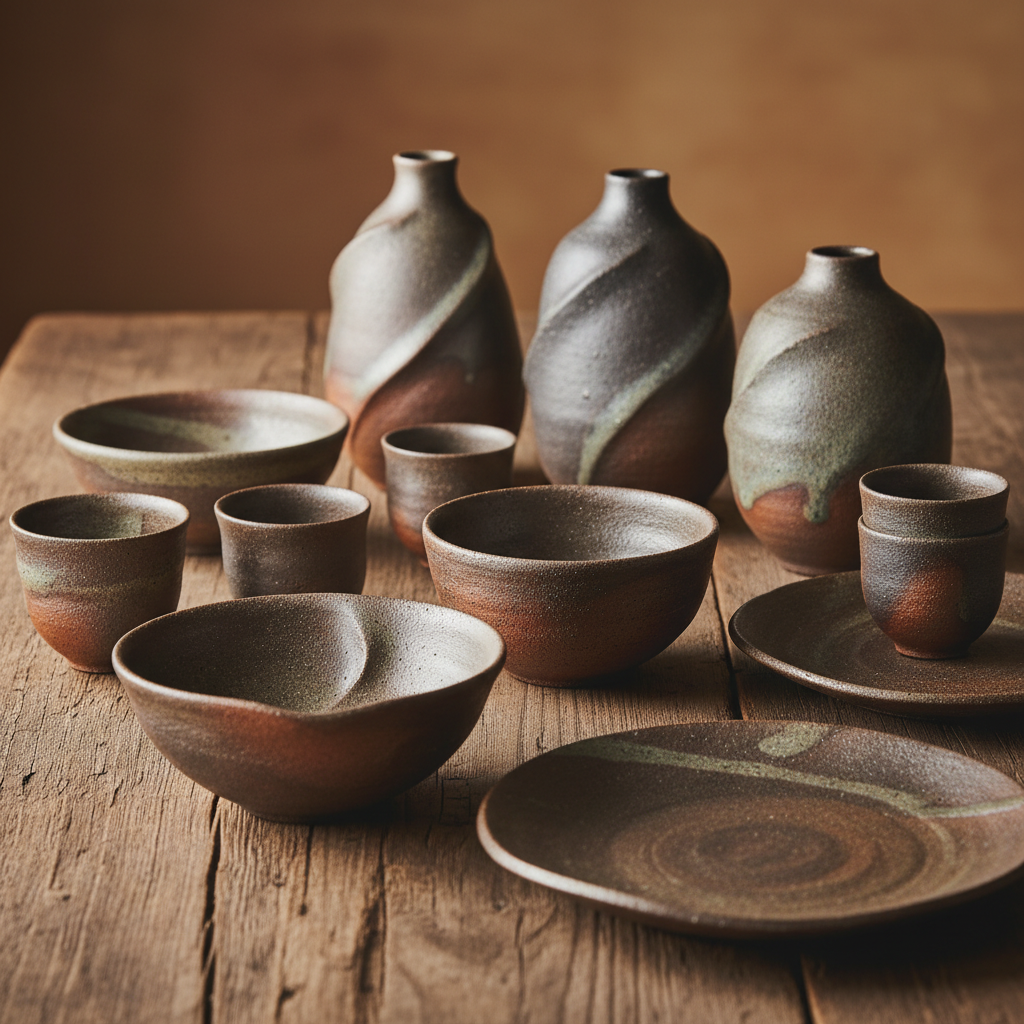
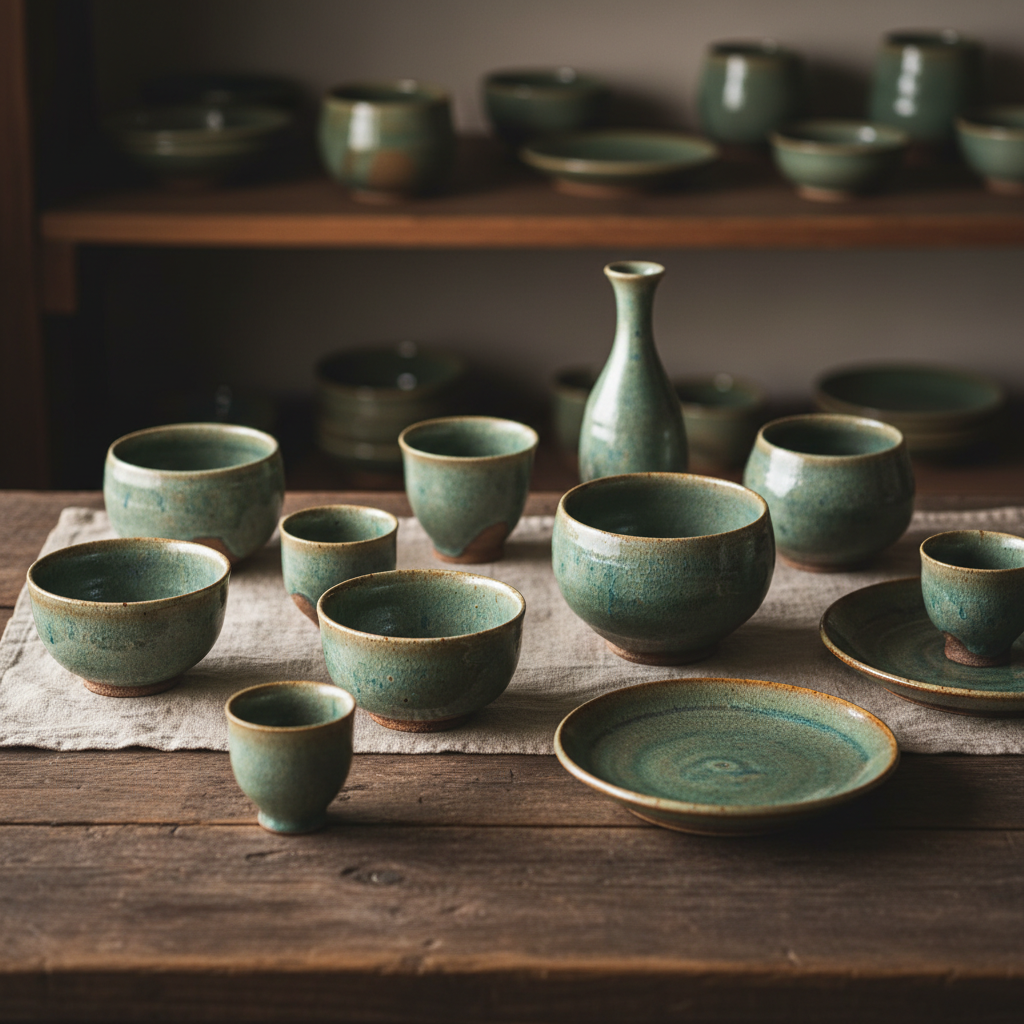
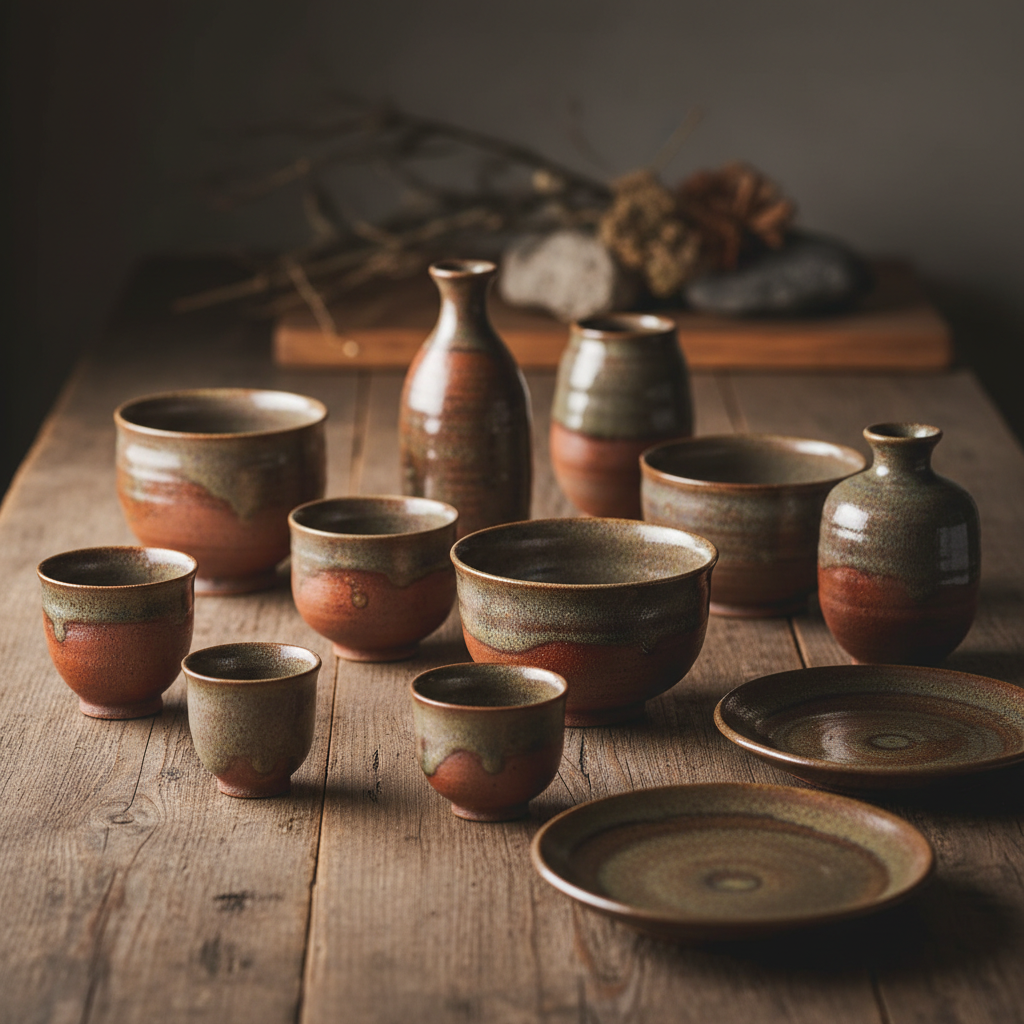
Sakazutsuyaki is characterized by a substantial construction with glaze thickly applied. Its lustrous, simple appearance combines durability and beauty suitable for long-term daily use.
The History of Sakazutsuyaki | From the Meiji Period to the Present
Founding Period: The Beginning of the Meiji Era
In Meiji 2 (1869), Suekichi Okamoto, a wealthy merchant of Kurashiki, took note that high-quality pottery clay could be obtained in the Sakazutsu district. At that time, Kurashiki was flourishing as a commercial city continuing from the Edo period, and the demand for daily-use vessels was increasing.
Okamoto Suekichi opened a kiln utilizing local pottery clay and began producing tableware and daily utensils. The commercially advantageous location of Kurashiki also contributed to Sakazutsuyaki developing as pottery rooted in the region’s daily life.
Period of Development: Production Rooted in the Community
From the Meiji through the Taisho and early Showa periods, Sakazutsuyaki functioned as a major supplier of daily necessities in the Kurashiki region. Its thick and sturdy construction was suitable for daily use and was widely accepted by local people.
The technique of applying glaze thoroughly, which prevented water leakage and allowed for the production of hygienic vessels, was also one of the reasons Sakazutsuyaki was supported.
Modern Era: Inheritance of Tradition and Challenges
In contemporary times, Sakazutsuyaki continues to preserve its tradition as Kurashiki’s oldest pottery. However, traditional ceramic production areas nationwide face difficult circumstances due to the proliferation of mass-produced goods and changes in lifestyles.
Sakazutsuyaki is no exception, but its historical value and unique aesthetic qualities continue to be appreciated by craft enthusiasts and people who value regional culture.
Characteristics and Manufacturing Methods of Sakazutsuyaki
Materials: High-Quality Local Pottery Clay
The greatest characteristic of Sakazutsuyaki is that it uses high-quality pottery clay obtained in the Sakazutsu district. This pottery clay has properties of stickiness, ease in forming, and high strength after firing.
By using local soil, not only can transportation costs be reduced, but the aesthetic qualities unique to that land can also be expressed in the vessels.
Glaze: Lustrous Finish with Thickly Applied Glaze
Sakazutsuyaki is characterized by glaze being applied thickly. This creates the following advantages:
- Lustrous, beautiful surface: Glaze covering the entire vessel results in a smooth, lustrous finish
- Improved water resistance: The glaze layer prevents water penetration, preventing water leakage even with prolonged use
- Hygiene: The smooth surface makes it difficult for dirt to adhere and easy to wash
- Color expression: Various colors can be expressed depending on the type of glaze and firing temperature
Form: Substantial, Heavy Construction
Another characteristic of Sakazutsuyaki is its substantial construction with thick firing. Compared to thin-walled vessels:
- High durability: Resistant to breaking in daily use and long-lasting
- Excellent heat retention: The thickness helps maintain the temperature of food and drinks
- Stability: The weight provides stability on the table
- Simple aesthetic: The thick vessel imparts a warm and inviting impression
Purpose: Practicality as Daily Utensils
Sakazutsuyaki has been produced as daily utensils since its founding. Various vessels used in daily life, centered on tableware (bowls, plates, vessels, etc.), are produced.
The design emphasizing practicality continues to be appreciated in modern times as “easy-to-use vessels.”
Ceramic Production Areas in Okayama Prefecture | The Positioning of Sakazutsuyaki
Okayama Prefecture has multiple ceramic production areas besides Sakazutsuyaki. Each production area has its own history and characteristics, and comparison with these is important for understanding Sakazutsuyaki.
Bizen Ware: Okayama’s Representative Ceramic
Bizen ware is the representative ceramic of Okayama Prefecture and is counted as one of Japan’s six ancient kilns.
- Production area: Ibe district, Bizen City, Okayama Prefecture
- History: Approximately 1,000 years of history continuing from the late Heian period
- Characteristics: “Yakishime” (fired-finish) technique without using glaze
- Appearance: Natural patterns from the soil’s properties and kiln temperature changes (hi-dasuki, goma, san-kiri, etc.)
- Texture: Rough soil texture, simple and powerful impression
While Bizen ware does not use glaze, Sakazutsuyaki applies glaze thoroughly, making the manufacturing methods quite different. If Bizen ware is called “the art of clay,” Sakazutsuyaki has a stronger character as “practical daily-use vessels.”
Mushiage Ware: Delicately Decorated Pottery
Mushiage ware (虫明焼) is also a traditional ceramic of Okayama Prefecture.
- Production area: Mushiage, Oku-cho, Setouchi City, Okayama Prefecture
- History: Founded in the mid-Edo period (18th century)
- Characteristics: Delicate painting and decoration
- Uses: Tea utensils, flower vessels, etc.
While Mushiage ware is characterized by highly artistic decoration, Sakazutsuyaki emphasizes simple aesthetics and practicality.
Comparison Table of Okayama Prefecture Ceramic Production Areas
| Production area | Location | Founding period | Main characteristics | Use of glaze |
|——–|——–|———-|———-|————|
| Bizen ware | Ibe, Bizen City | Late Heian period | Fired-finish, natural patterns | Not used |
| Sakazutsuyaki | Sakazutsu, Kurashiki City | Meiji 2 (1869) | Substantial, lustrous appearance | Thoroughly used |
| Mushiage ware | Mushiage, Setouchi City | Mid-Edo period | Delicate painting | Used |
This comparison shows that ceramic production areas within Okayama Prefecture have different individual characteristics. Sakazutsuyaki, though founded in the relatively recent Meiji period, has established its own position as Kurashiki’s oldest pottery.
Sakazutsuyaki in Japan’s Ceramic Production Areas
Japan has numerous ceramic production areas nationwide. To understand Sakazutsuyaki in a national context, let us view Japan’s major ceramic production areas by region.
Ceramic Production Areas in Hokkaido
Hokkaido has production areas such as Ebetsu ware. Many are relatively new production areas, centered on those that developed after the modern era.
Ceramic Production Areas in the Tohoku Region
- Aizu Hongouyaki (会津本郷焼) (Fukushima Prefecture): The oldest ceramic production area in the Tohoku region
- Oohori Soma ware (大堀相馬焼) (Fukushima Prefecture): Characterized by blue crackle patterns
- Soma Komayaki (相馬駒焼) (Fukushima Prefecture): Characterized by horse drawings
Ceramics in the Tohoku region developed by emphasizing practicality in harsh climates.
Ceramic Production Areas in the Kanto Region
- Kasama ware (笠間焼) (Ibaraki Prefecture): The representative ceramic production area of the Kanto region
- Mashiko ware (益子焼) (Tochigi Prefecture): A production area that became famous through the folk art movement
- Komagata ware (小鹿田焼) (Tochigi Prefecture): Preserving traditional techniques
The Kanto region developed diverse ceramic production areas because it was home to Edo (Tokyo), a large consumer market.
Ceramic Production Areas in the Chubu Region
The Chubu region is Japan’s largest ceramic production area.
- Seto ware (瀬戸焼) (Aichi Prefecture): One of Japan’s six ancient kilns, the origin of the term “setomono”
- Tokoname ware (常滑焼) (Aichi Prefecture): One of Japan’s six ancient kilns, famous for teapots
- Mino ware (美濃焼) (Gifu Prefecture): Japan’s largest ceramic production volume
- Kutani ware (九谷焼) (Ishikawa Prefecture): Characterized by lavish, colorful painting
- Echizen ware (越前焼) (Fukui Prefecture): One of Japan’s six ancient kilns
The Chubu region, particularly Aichi and Gifu prefectures, remains the center of ceramic production in Japan today.
Ceramic Production Areas in the Kansai Region
- Shigaraki ware (信楽焼) (Shiga Prefecture): One of Japan’s six ancient kilns, famous for raccoon dog figurines
- Tamba ware (丹波焼) (Hyogo Prefecture): One of Japan’s six ancient kilns
- Kyoto ware/Kiyomizu ware (京焼・清水焼) (Kyoto Prefecture): Characterized by elegant decoration
The Kansai region developed artistically sophisticated ceramics because Kyoto served as the center of culture.
Ceramic Production Areas in the Chugoku Region
The Chugoku region has diverse production areas including Sakazutsuyaki.
- Bizen ware (備前焼) (Okayama Prefecture): One of Japan’s six ancient kilns
- Sakazutsuyaki (酒津焼) (Okayama Prefecture): Kurashiki’s oldest pottery
- Mushiage ware (虫明焼) (Okayama Prefecture): Delicate decoration
- Hashima ware (羽島焼) (Okayama Prefecture): Traditional techniques
- Miyajima ware (宮島焼) (Hiroshima Prefecture): Developed as Miyajima souvenirs
- Hagi ware (萩焼) (Yamaguchi Prefecture): Highly valued as tea ware
- Horikoshi ware (堀越焼) (Yamaguchi Prefecture): Simple aesthetic
The Chugoku region both possesses renowned production areas such as Bizen ware and Hagi ware, while also accommodating community-focused production areas like Sakazutsuyaki.
Ceramic Production Areas in the Shikoku Region
- Otani ware (大谷焼) (Tokushima Prefecture): Characterized by large-scale ceramics
- Tobe ware (砥部焼) (Ehime Prefecture): White porcelain with blue-colored painting
- Rihei ware (理平焼) (Kagawa Prefecture): Traditional techniques
- Okamoto ware (岡本焼) (Kagawa Prefecture): Regional daily-use goods
Ceramics in the Shikoku region center on practical goods closely connected to regional life.
Ceramic Production Areas in the Kyushu Region
The Kyushu region is the birthplace of Japanese porcelain and has diverse production areas.
- Arita ware (有田焼) (Saga Prefecture): Japan’s first porcelain, lavish decoration
- Imari ware (伊万里焼) (Saga Prefecture): Named after the port of shipment for Arita ware
- Karatsu ware (唐津焼) (Saga Prefecture): Called “first Raku, second Hagi, third Karatsu” among tea wares
- Satsuma ware (薩摩焼) (Kagoshima Prefecture): White Satsuma and black Satsuma
- Shiro ware (小代焼) (Kumamoto Prefecture): Powerful forms
- Otagayaki (小鹿田焼) (Oita Prefecture): Preserving traditional techniques
- Ueno ware (上野焼) (Fukuoka Prefecture): Developed as tea ware
- Takatori ware (高取焼) (Fukuoka Prefecture): Renowned as tea ware
The Kyushu region established the foundation of Japanese ceramic culture through technological transmission from the Korean Peninsula.
Characteristics of Sakazutsuyaki Among National Ceramic Production Areas
Compared with ceramic production areas nationwide, Sakazutsuyaki has the following characteristics:
- A relatively new production area founded in the Meiji period: It does not have the ancient history of Japan’s six ancient kilns, but possesses a tradition of over 150 years
- Daily-use ceramics emphasizing practicality: Production centers on vessels for daily use rather than art objects
- A community-focused production area: Production activities rooted in the region of Kurashiki
- Lustrous finish utilizing glaze: An approach different from Bizen ware’s fired-finish technique
- Substantial, heavy construction: Design emphasizing durability and practicality
While Sakazutsuyaki does not match the nationwide recognition of Bizen ware or Arita ware, it possesses unique value rooted in regional culture and daily life.
The Current State and Challenges of Sakazutsuyaki
Inheritance of Tradition
Sakazutsuyaki has a history of over 150 years since its founding in Meiji 2, and is Kurashiki’s oldest pottery. However, in modern times, it shares challenges that traditional ceramic production areas as a whole face.
Main challenges:
- Shortage of successors: Aging of ceramic artists and nurturing of young talent
- Changes in lifestyle: Decrease in demand for ceramics as daily-use items
- Competition with mass-produced goods: Price competition with inexpensive industrial products
- Raising awareness: Lower recognition compared to Bizen ware
Value as Regional Culture
On the other hand, Sakazutsuyaki is an important entity conveying Kurashiki’s history and culture. Kurashiki City is known as a tourist destination for its Bikan Historical Area and Ohara Museum of Art, and Sakazutsuyaki as a regional traditional craft has the following value:
- Historical value: Historical significance as Kurashiki’s oldest pottery
- Cultural value: An entity transmitting regional living culture
- Educational value: Opportunity to learn traditional crafts’ techniques and spirit
- Tourism resource: Regional resource conveying the appeal of Kurashiki
Possibilities in Modern Times
Possibilities that Sakazutsuyaki possesses in modern times include:
- Warmth of handmade: The appeal of handmade crafts not found in mass-produced goods
- Environmental considerations: Sustainable production using local materials
- Development as a regional brand: Cooperation with the Kurashiki brand
- Experience-based tourism: Converting ceramic experiences into tourism content
- Contemporary design: Development of contemporary vessels utilizing traditional techniques
Enjoying Sakazutsuyaki | Purchasing and Experiencing
Methods of Purchasing Sakazutsuyaki
If you wish to purchase Sakazutsuyaki, the following methods are available:
- Local kilns: Direct visits to kilns in the Sakazutsu district of Kurashiki
- Kurashiki souvenir shops: Souvenir shops in the Bikan Historical Area, etc.
- Okayama Prefecture craft shops: Shops dealing in traditional crafts within Okayama City and other locations
- Online shops: Purchasing via the Internet
How to Choose Sakazutsuyaki
Points to consider when selecting Sakazutsuyaki:
- Clarify the purpose: Is it for daily use or special occasions?
- Confirm the size: Imagine the actual scene of use and select the size
- Confirm the weight: Since the vessels are thick, check for ease of handling
- Glaze color: Consider personal preference and harmony with other tableware
- Artist’s individuality: Different kilns and artists have different characteristics, so find ones to your liking
Care Methods for Sakazutsuyaki
Care methods for long-term use of Sakazutsuyaki:
- Pre-use treatment: Before first use, “seasoning” by boiling in rice water is beneficial
- Washing: Wash promptly after use and dry thoroughly
- Storage: Store after complete drying
- Avoid rapid temperature changes: Avoid sudden temperature changes such as pouring cold water on hot vessels
- Regular inspection: Periodically check for cracks and other issues
Kurashiki and Ceramic Culture
Historical Background of Kurashiki
Kurashiki City flourished in the Edo period as a tenryo (directly controlled territory of the shogunate) and commercial city. It developed as a distribution center for goods utilizing water transport on the Takahashi River, and many wealthy merchants were born there.
Suekichi Okamoto, the founder of Sakazutsuyaki, was one of such wealthy merchants of Kurashiki. In commercially prosperous Kurashiki, the demand for daily-use vessels was high, and conditions were in place for ceramic production locally.
Bikan Historical Area and Crafts
Modern-day Kurashiki City is known as a tourist destination for the Bikan Historical Area with its beautiful white-walled streets. The historical area has many shops dealing in traditional crafts, and alongside Kurashiki glass and Kurashiki canvas, Sakazutsuyaki is sometimes introduced as a craft of Kurashiki.
Coexistence with Bizen Ware
Within Okayama Prefecture, there is Bizen ware, one of Japan’s six ancient kilns, a renowned ceramic production area. Bizen ware is highly evaluated domestically and internationally, and is the traditional craft representative of Okayama Prefecture.
While Sakazutsuyaki does not have the level of recognition of Bizen ware, it possesses different characteristics from Bizen ware with its lustrous finish using glaze, and the two coexist rather than compete, each leveraging their individual characteristics.
Classification and Characteristics of Ceramic Production Areas
Differences Between Pottery and Porcelain
Ceramics are broadly classified into “pottery” and “porcelain.” Sakazutsuyaki is classified as “pottery.”
Characteristics of pottery:
- Raw material: Pottery clay (clay)
- Firing temperature: Approximately 800–1,250°C
- Texture: Has the warmth of earth, somewhat rough
- Water absorption: Slightly absorbent
- Sound when struck: Dull sound
- Examples: Bizen ware, Hagi ware, Mashiko ware, Sakazutsuyaki, etc.
Characteristics of porcelain:
- Raw material: Ceramic stone (feldspar, quartz, etc.)
- Firing temperature: Approximately 1,250–1,400°C
- Texture: Smooth and hard, white with translucence
- Water absorption: Virtually non-absorbent
- Sound when struck: High metallic sound
- Examples: Arita ware, Kutani ware, Tobe ware, etc.
Since Sakazutsuyaki is pottery, its appeal lies in an aesthetic that conveys the warmth of earth.
Classification by Presence or Absence of Glaze
Ceramics can also be classified by whether glaze is used.
Glazed pottery (using glaze):
- Smooth surface with luster
- Low water absorption
- Rich color expression
- Examples: Sakazutsuyaki, Hagi ware, Mino ware, etc.
Unglazed pottery (not using glaze):
- The texture of clay is expressed as is
- Natural patterns emerge
- Flavor increases with use
- Examples: Bizen ware, some Shigaraki ware, etc.
Sakazutsuyaki is glazed pottery with glaze thoroughly applied, and is characterized by its lustrous beautiful surface.
Japanese Ceramic Culture and Sakazutsuyaki
Ceramics as Daily-Use Items
Japanese ceramic culture has two major currents. One is artistically sophisticated ceramics as tea ware and art objects; the other is practical ceramics for daily life.
Sakazutsuyaki inherits the tradition of “ceramics as daily-use items,” the latter. Sakazutsuyaki developed as pottery closely connected to daily life, having centered production on tableware and daily utensils since its founding.
Relationship with the Folk Art Movement
In the early 20th century, the folk art movement, advocated by Soetsu Yanagi and others, reassessed the beauty of everyday-use crafts. Through this movement, previously unnoticed production areas such as Mashiko ware and Otani ware gained prominence.
Sakazutsuyaki can be said to embody the “beauty of use” that the folk art movement valued. Its thick construction emphasizing practicality and simple aesthetics align with the spirit of folk art.
Contemporary Life and Traditional Crafts
Modern lifestyles have greatly changed the environment surrounding ceramics. With the prevalence of materials such as plastic and stainless steel, demand for traditional ceramics has decreased.
At the same time, interest in the warmth of handmade items and environmentally friendly materials is also increasing. Traditional ceramics like Sakazutsuyaki may receive new appreciation as possessing value not found in mass-produced goods.
Conclusion: The Appeal and Future Prospects of Sakazutsuyaki
Sakazutsuyaki is Kurashiki’s oldest ceramic production area, founded in Meiji 2 (1869) in the Sakazutsu district of Kurashiki City, Okayama Prefecture. Using high-quality local pottery clay, it is characterized by a lustrous finish with glaze thickly applied and substantial, heavy construction.
While Japan has numerous ceramic production areas, Sakazutsuyaki has a unique history rooted in daily life in its region as daily-use ceramics. Although it does not have nationwide recognition like Bizen ware, it continues to preserve its tradition of over 150 years as an important entity conveying Kurashiki’s history and culture.
In modern times, it faces many challenges including a shortage of successors and changes in lifestyles, but the possibilities Sakazutsuyaki possesses are far from limited: the warmth of handmade goods, the value of conveying regional culture, environmentally conscious production methods, and more.
When visiting Kurashiki, why not turn your attention to Sakazutsuyaki, Kurashiki’s oldest pottery, in addition to sightseeing in the Bikan Historical Area? By actually handling and using it, you can feel the techniques passed down for over 150 years and the craftsperson’s intentions embedded in these practical vessels.
Okayama Prefecture’s ceramic culture is not limited to Bizen ware. By turning attention to community-rooted production areas like Sakazutsuyaki, a richer world of ceramics can be enjoyed.