
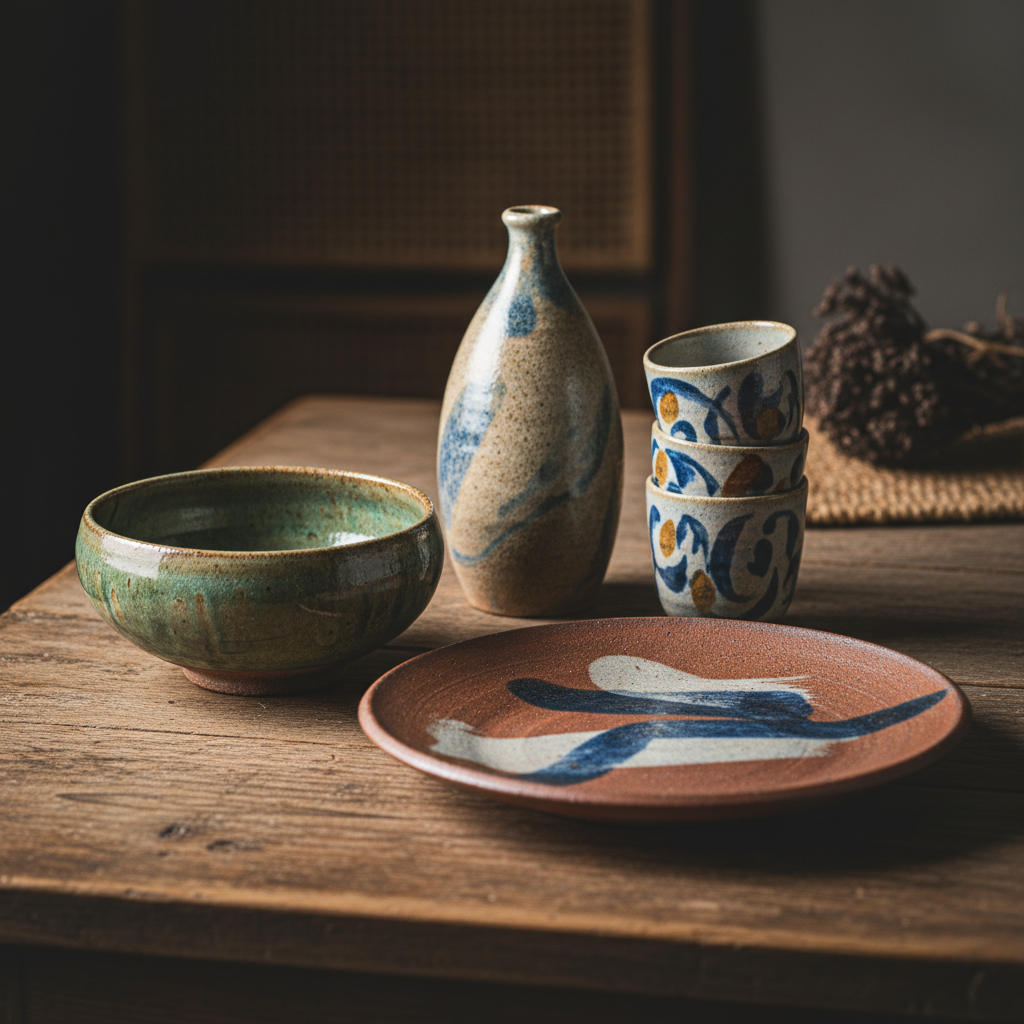
Tsugaru Yaki: A Complete Guide to Aomori Prefecture’s Traditional Ceramics – History, Characteristics, and Kilns
Tsugaru yaki, fired primarily in Hirosaki City, Aomori Prefecture, is a traditional ceramic production center with a history spanning over 300 years. Developing under the patronage of the Tsugaru clan, it is now known as a representative traditional craft of Aomori Prefecture. This article provides a comprehensive overview of Tsugaru yaki ceramics, covering its history, characteristics, kiln operations, and contemporary appeal.
What is Tsugaru Yaki – Aomori Prefecture’s Representative Ceramic Production Center
Tsugaru yaki (津軽焼) is a collective term for pottery produced in Hirosaki City and surrounding areas of Aomori Prefecture. This production center began in 1697 (the 10th year of the Genroku era), when the fourth daimyo of the Tsugaru clan, Tsugaru Nobumasatsu, gathered potters and established kilns to achieve ceramic self-sufficiency within the domain.
Four Kilns That Form the Origins of Tsugaru Yaki
The name “Tsugaru yaki” actually refers to a collective term for multiple kilns. During the feudal period, the following four kilns existed, each named after their respective locations.
Hirahimizu Yaki (平清水焼)
Pottery fired in the Hirahimizu district of Hirosaki City, forming one of the central kilns of Tsugaru yaki. Using local clay, it produced a wide range of items from everyday utensils to furnishings.
Oosawa Yaki (大沢焼)
Pottery fired in the Oosawa district, characterized by rustic aesthetics. During the feudal period, it primarily produced everyday items for common people.
Shimokawara Yaki (下川原焼)
A kiln in the Shimokawara district, also known for producing clay figurines. It possessed a unique kiln culture, engaging in both pottery and clay figurine production.
Akudo Yaki (悪土焼)
A kiln named after the Akudo (悪土) location, distinguished by its clay quality. These four kilns formed the origins of Tsugaru yaki.
Ceramic Industry Development by the Tsugaru Clan
The background to Nobumasatsu gathering potters involved the economic policies of the time. Since purchasing ceramics from other domains or countries strained the clan’s finances, the clan aimed for self-sufficiency in ceramic production. The potters received support for improving their techniques, and production of ceramics for the clan’s furnishings and everyday items was encouraged.
Throughout the feudal period, Tsugaru yaki continued developing under the patronage of the Tsugaru clan. Potters researched local clay, worked on developing glazes, and cultivated a unique ceramic culture distinctive to Tsugaru.
History of Tsugaru Yaki – From the Edo Period to Modern Times
Edo Period – Development as a Domain Kiln
From its establishment in 1697 (Genroku 10), Tsugaru yaki developed under government protection. Potters honed their skills, producing tableware, tea ceremony utensils, and flower vases for the Tsugaru clan’s samurai and merchants. Throughout the feudal period, ceramics were primarily fired for the clan’s furnishings and everyday items, becoming an important industry supporting the region’s living culture.
Meiji Period – Crisis of Decline
The Meiji period marked a major turning point for Tsugaru yaki. When the Tohoku Main Line opened to Aomori in 1891 (Meiji 24), mass-produced ceramics from other prefectures began flowing in by rail. Facing competition from mass-produced, inexpensive ceramics such as Seto ware and Mino ware, Tsugaru yaki kiln operators were forced to close one after another.
By the Taisho period, most of the four kilns had ceased production, and Tsugaru yaki faced an existential crisis. There was even a possibility that a ceramic production center with nearly 300 years of history would disappear entirely.
Showa Period – Path to Revitalization
In the Showa period, efforts to revitalize Tsugaru yaki began. Local potters and enthusiasts worked to restore traditional techniques, and new kiln operations were established. Particularly after the war, pieces that capitalized on the character of local clay were increasingly produced, and Tsugaru yaki gradually revived.
From the 1970s onward, pottery that preserved tradition while adapting to modern living styles was developed, and Tsugaru yaki became recognized as a representative traditional craft of Aomori Prefecture.
Modern Times – Fusion of Tradition and Innovation
Today’s Tsugaru yaki continues to inherit traditional techniques while adapting to modern lifestyles. While maintaining commitment to local materials, it continues to innovate in design and function, evolving as ceramics that appeal to younger generations.
Characteristics of Tsugaru Yaki – Unique Qualities from Local Materials
Rustic Aesthetics Using Local Clay
The greatest characteristic of Tsugaru yaki is its use of clay from Aomori Prefecture. The clay extracted from the Hirosaki area contains abundant iron, producing a distinctive color after firing. Maximizing the character of this local clay serves as the fundamental philosophy of Tsugaru yaki.
Potters carefully process the clay from the beginning, discerning the clay’s properties while shaping it. The drying process is carefully managed according to climate conditions, progressing through the traditional stages of bisque firing, glaze application, and final firing.
Apple Wood Glaze – A Glaze Unique to Tsugaru
The representative glaze of Tsugaru yaki is “apple wood glaze” (りんご釉). This glaze uses wood ash from apple trees, Aomori Prefecture’s specialty product, as its raw material, producing Tsugaru yaki’s distinctive color. The components contained in apple wood ash display unique coloration during firing, creating a warm color tone.
Apple wood glaze displays various expressions depending on firing conditions, ranging from pale greenish hues to tea brown. The element of chance inherent in this naturally-sourced glaze is one of its attractions.
Rich Colors from Black Tenmoku Glaze
Another representative glaze is black tenmoku glaze. High-temperature firing of a glaze rich in iron content produces beautiful colors of deep black or dark brown. Black tenmoku glaze is also used in tea ceremony ware, producing pieces with a dignified atmosphere.
The black tenmoku glaze subtly changes expression depending on light, and is said to increase in character through use.
Rustic and Warm Texture
A characteristic shared across all Tsugaru yaki is rustic, warm texture. With minimal decorative ornamentation and designs that highlight clay texture, most pieces are favored as everyday tableware. Pieces that resonate with the user’s senses through their ease of handling, pleasant mouth-feel, and harmony with food represent the tradition of Tsugaru yaki craftsmanship.
Tsugaru Yaki Production Process – Inheritance of Traditional Techniques
Clay Extraction and Preparation
The production of Tsugaru yaki begins with extracting local clay. Clay extracted from mountains and fields around Hirosaki is purified of impurities and adjusted to the appropriate moisture content. Clay preparation is a fundamental pottery technique, removing air from the clay and creating a uniform state—an essential step.
Experienced potters judge clay condition through hand sensation, adjusting to optimal hardness. The care taken in clay preparation determines the final product’s quality.
Shaping – Wheel-Throwing and Hand-Building
Shaping employs either electric wheel-throwing or hand-building techniques. In wheel-throwing, clay is lifted while rotating on a spinning wheel to create bowls, plates, pots, and other forms. This requires considerable skill, with the ability to accurately reproduce the same form acquired through years of practice.
Hand-building, molding clay by hand, allows for greater freedom of form. This technique is often used for figurative pieces such as flower vases and decorative objects.
Drying and Bisque Firing
After shaping, pieces dry slowly. Rapid drying causes cracking, so temperature and humidity are controlled while pieces dry over several days to weeks.
Once sufficiently dry, bisque firing is conducted at approximately 800 degrees Celsius. Bisque firing hardens the clay and makes it receptive to glaze application.
Glaze Application and Final Firing
Glaze is applied to bisque-fired pieces. Glazes such as apple wood glaze or black tenmoku are selected according to the piece’s purpose and design, applied uniformly through brushing or immersion.
After glaze application, pieces undergo final firing at 1200 to 1300 degrees Celsius. This high-temperature firing causes the glaze to melt, forming a vitreous layer that produces beautiful coloration and luster. Temperature control and firing duration during final firing rely significantly on the potter’s experience and intuition.
Major Tsugaru Yaki Kilns – Craftspeople Preserving Tradition
Tsugaru Chiyozou Kiln
Tsugaru Chiyozou Kiln represents one of modern Tsugaru yaki’s leading operations. While unpretentiously inheriting tradition, it aims for pottery that fits seamlessly into contemporary living. Committed to local materials, it primarily produces pieces featuring apple wood glaze.
Handling a wide range of work from everyday tableware to tea ceremony utensils, the kiln continues creating ceramics that gently harmonize with the hand, eye, and heart, as organic meals nourish the body. With a workshop in Hirosaki City, it also offers sales and pottery experience activities.
Tsugaru Kanayama Yaki
Tsugaru Kanayama Yaki is a kiln with distinctive production methods within Tsugaru yaki. It employs “firing and hardening” (焼き締め) technique, using no glaze and slowly firing at 1350 degrees Celsius.
Using high-quality clay that accumulated at the bottom of Kanayama’s Ootameike Pond and red pine from mountain forests as fuel, it produces work influenced by the strong impact of ancient Sue ware once made in this location. Its pieces, with their uniquely profound character, are valued for their warmth that soothes the hearts of people living in modern times.
Tsugaru Ujou Yaki
Tsugaru Ujou Yaki focuses on hand-crafting, wood-kiln firing, and natural glazing. It also produces many artistic works by contemporary artists and collaborates with the Hirosaki Tea Ceremony Art Museum.
While preserving traditional techniques, its works incorporating contemporary sensibilities receive high evaluation both domestically and internationally.
Appeal of Tsugaru Yaki – Individuality Found Nowhere Else
Uniqueness Created by Aomori’s Natural Environment
Tsugaru yaki’s appeal deeply relates to Aomori’s environment. The glaze using apple wood ash derives from an idea possible only in Aomori, where apple cultivation thrives. By using local clay and local materials, a uniqueness emerges that no other ceramic production center can create.
The harsh winter cold, abundant nature, and Tsugaru’s cultural environment influence the rustic, warm aesthetic characteristic of Tsugaru yaki.
Practical Suitability for Daily Use
Tsugaru yaki is made with daily table use as its premise. Ease of handling, pleasant mouth-feel, and food compatibility represent practical priorities in pottery making, a tradition upheld by Tsugaru yaki.
Increasingly, modern pieces accommodate microwave ovens and dishwashers, allowing traditional crafts to adapt to contemporary lifestyles.
Individual Expressions in Each Piece
Hand-made Tsugaru yaki exhibits subtle differences in each piece’s expression. Glaze flow, firing-induced color variation—even identical pieces show individual differences, providing the character of handcrafted work.
Obtaining a one-of-a-kind piece represents another appeal of Tsugaru yaki.
Places to Experience and Purchase Tsugaru Yaki
Direct Purchase at Kilns
Kiln operations including Tsugaru Chiyozou Kiln sell work directly through galleries adjoining their workshops. Discussing with makers while viewing their backgrounds and usage represents a major appeal of kiln purchases.
Multiple kiln operations exist within Hirosaki City, each developing individual work. Contacting kilns in advance before visiting is recommended.
Pottery Experience Classes
Many kilns offer pottery experience classes. Through wheel-throwing and hand-building experiences, visitors can experience Tsugaru yaki’s production process firsthand. Services exist where self-made pieces receive firing and mail delivery upon completion.
Beginners receive careful instruction, making these classes popular for creating travel memories.
Aomori Prefecture Regional Products Halls and Galleries
Regional products halls and craft galleries within Hirosaki and Aomori cities also sell Tsugaru yaki. Comparing multiple kiln operations’ work while selecting represents an advantage for first-time Tsugaru yaki purchasers.
Retailers exist in accessible locations such as near JR Hirosaki Station and tourist facilities.
Online Shops
Recently, kiln operations and specialty retailers’ online shops have made Tsugaru yaki available for purchase. Distant customers can readily obtain Tsugaru yaki.
Using product photographs and descriptions as reference, customers can select pieces matching their preferences.
Tsugaru Yaki and Other Aomori Prefecture Ceramics
Differences from Hachinohe Yaki
Besides Tsugaru yaki, Aomori Prefecture features Hachinohe yaki, a ceramic production center centered in Hachinohe City. Hachinohe yaki, also beginning in the Edo period, possesses distinctive characteristics differing from Tsugaru yaki.
Hachinohe yaki is characterized by blue-green glaze, presenting different color tones from Tsugaru yaki’s apple wood glaze or black tenmoku glaze. Different regions within Aomori developed their own distinctive ceramic cultures.
Shimokawara Yaki Clay Figurines
Shimokawara yaki, one of Tsugaru yaki’s origins, is also known for clay figurine production. Shimokawara yaki clay figurines, featuring charming, rustic expressions, continue being created as folk toys today.
The tradition of engaging in both pottery and clay figure production represents a unique culture of Shimokawara yaki.
Contemporary Development of Tsugaru Yaki
Rise of Young Artists
Recently, young artists have increasingly entered the Tsugaru yaki field. While learning traditional techniques, they create work incorporating contemporary design sensibilities, expanding Tsugaru yaki’s possibilities.
Pieces suited to café culture, such as coffee cups, or simply designed tableware following Nordic aesthetics, are being created for modern lifestyles.
Collaboration Products
Tsugaru yaki items developed through collaborations with local restaurants and hotels are increasing. Some Hirosaki restaurants serve cuisine on Tsugaru yaki vessels, allowing diners to enjoy food and ceramics in harmony.
Collaboration products with local enterprises continue being developed, creating new demand for Tsugaru yaki.
International Expansion
Tsugaru yaki has gained attention internationally. As Japanese traditional crafts, it has been exhibited at shows in Western countries and Asia, receiving high evaluation.
Simple, functional designs appeal to consumers abroad who favor minimalism, with exports showing increasing trends.
Preservation and Transmission of Tsugaru Yaki
Traditional Craft Designation
Tsugaru yaki holds designation as an Aomori Prefecture traditional craft, receiving administrative support. Training systems for technique transmission and business support initiatives for expanding sales channels are conducted.
Traditional craft certification enhances Tsugaru yaki’s brand value and plays an important role in gaining consumer confidence.
Successor Development
Tsugaru yaki kiln operations emphasize successor development. Through apprenticeship systems and trainee acceptance, efforts to transmit traditional techniques continue.
Collaborations with local high schools and specialty schools are progressing, actively working to communicate Tsugaru yaki’s appeal to younger generations.
Cultural Transmission
Tsugaru yaki represents not merely craft items but Tsugaru’s culture itself. Local festivals and events incorporate Tsugaru yaki, establishing it as part of the region’s culture.
Efforts to convey regional history and culture to future generations through Tsugaru yaki are increasingly valued.
Conclusion – Tsugaru Yaki’s Appeal and Future
Tsugaru yaki is a ceramic production center with over 300 years of history since its establishment in 1697, representing Aomori Prefecture. Originating from four kilns—Hirahimizu yaki, Oosawa yaki, Shimokawara yaki, and Akudo yaki—it developed under Tsugaru clan patronage.
Facing decline from ceramic influx through rail expansion in the Meiji period, it was revitalized during the Showa period and today represents ceramics fusing tradition with innovation.
Local clay’s rustic aesthetics, apple wood glaze derived from Aomori’s specialty fruit, and deep colors from black tenmoku glaze characterize Tsugaru yaki, captivating many. Individually distinctive kiln operations including Tsugaru Chiyozou Kiln, Tsugaru Kanayama Yaki, and Tsugaru Ujou Yaki continue creating new works while preserving tradition.
Contemporary development shows young artists’ emergence, collaboration product development, and international expansion. Maintaining value as traditional crafts while creating pottery that blends into modern living, Tsugaru yaki will continue developing as a ceramic production center representing Aomori Prefecture’s culture.
When visiting Hirosaki, please visit kiln operations to experience Tsugaru yaki’s appeal firsthand. Through handling, using, and developing pieces over time, you will surely appreciate Tsugaru yaki’s true quality.
