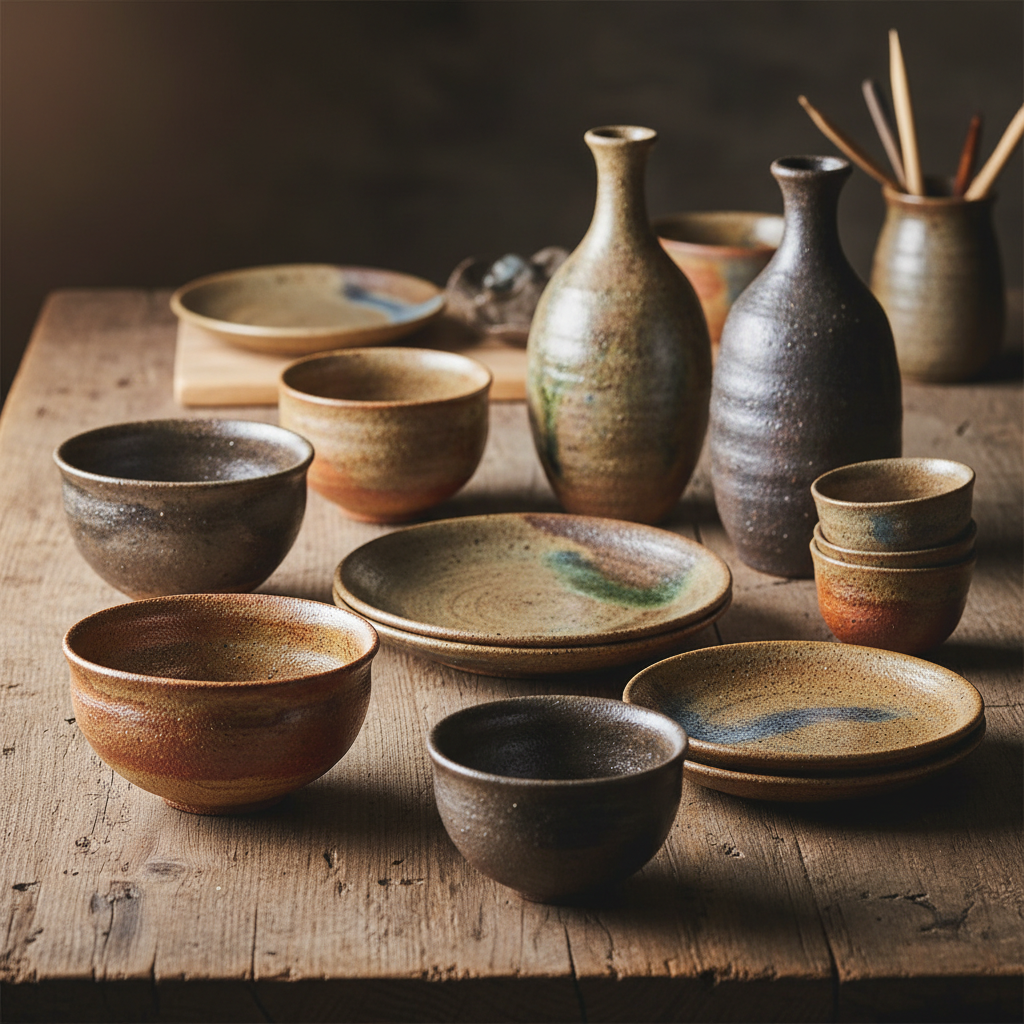

Kotoyaki: A Comprehensive Explanation of the History and Characteristics of Hikone, Shiga Prefecture’s Phantom Kiln
What is Kotoyaki (Pottery from Lake Biwa’s East)?
Kotoyaki is ceramic ware produced in Hikone Domain, Shiga Prefecture, during the late Edo period. “Kotou” refers to a broad regional name for the territories of Hikone Domain located on the eastern shore of Lake Biwa, and the name derives from the ceramics being fired in this region.
The kiln was opened in 1829 (Bunsei 12) by Kenuya Hanbei, a merchant in Hikone Castle town, and was taken over by Hikone Domain in 1842 (Tenpo 13) to become a domain kiln. However, it ceased operations in 1862 (Bunki 2), lasting only about 30 years, earning it the reputation of a “phantom kiln.”
The greatest characteristic of Kotoyaki lies in high-quality products made primarily of porcelain. Using diverse techniques such as underglaze blue (sometsuke), red overglaze painting, red overglaze with gold decoration, multicolor overglaze (nishikide), and celadon, various works were created and sold nationwide through Osaka to cities like Edo. Particularly during the tenure of Ii Naosuke as domain lord, the kiln management received passionate attention, and the domain kiln reached its golden age.
The History of Kotoyaki: From Opening to Closure
Opening of the Kiln by Kenuya Hanbei (Bunsei 12, 1829)
The history of Kotoyaki began when Kenuya Hanbei (1790–1860), who ran a used clothing business in Hikone Castle town, conceived the idea of introducing porcelain firing, a cutting-edge technology at the time. Hanbei invited craftsmen from the Imari ware production area and initially built a kiln on Sariyama on the southern bank of Serikawa River.
However, technical problems arose at this location, so the kiln was relocated to Mochigi Valley at the foot of Sawayama (near present-day Furusawa town, Hikone City). This relocation proved to be the key to success, enabling the successful firing of high-quality porcelain. The Kenuya kiln produced sophisticated porcelain such as underglaze blue and red overglaze pieces and achieved commercial success.
Domain Kiln Takeover by Hikone Domain (Tenpo 13, 1842)
In 1842 (Tenpo 13), the kiln of Kenuya Hanbei was taken over by Ii Naoaki, the 12th domain lord of Hikone, and became a directly managed domain kiln. With the transition to domain kiln status, the kiln and related facilities underwent major reconstruction and expansion, and production facilities extended beyond Furusawa Village to include Hikone Yanagimachi and Ishigasaki Village (Ishigasaki town).
The Kotoyaki domain kiln established a system to recruit outstanding potters from throughout the country. Skilled craftsmen were invited from production areas such as Seto ware, Kutani ware, Kyoto ware, and Imari ware, and by integrating techniques from various regions, a sophisticated technical system unique to Kotoyaki was established.
The Golden Age of Kotoyaki under Ii Naosuke (Ansei Period)
The Kotoyaki kiln reached its peak during the tenure of Ii Naosuke, the 13th domain lord of Hikone Domain. Naosuke was proficient in the tea ceremony and possessed deep knowledge of art and craft, so he devoted considerable passion to the management of the Kotoyaki kiln.
During the Ansei period (1854–1860), the domain kiln’s equipment was further enhanced and the production system was organized. Naosuke himself was involved in quality control of products and is said to have issued instructions regarding design and technique. Kotoyaki produced during this period reached the highest technical and artistic standards and gained nationwide fame.
The Sakurada Gate Incident and Closure of the Kiln (Bunki 2, 1862)
However, when Ii Naosuke was assassinated in the Sakurada Gate Incident on March 3, 1860 (Ansei 7), the situation surrounding Kotoyaki changed dramatically. After Naosuke’s death, Hikone Domain entered a period of late Edo turmoil, making it difficult to maintain the kiln both financially and politically.
During the tenure of the 14th domain lord, Ii Naonobu, the domain kiln of Kotoyaki was forced to cease operations in August 1862 (Bunki 2). Merely 33 years after opening and just over 20 years since becoming a domain kiln, the enterprise came to an end. This sudden closure left Kotoyaki with the legacy of a “phantom kiln” in history.
Characteristics and Techniques of Kotoyaki
Porcelain-Based Products
The greatest characteristic of Kotoyaki lies in its focus on porcelain as the primary product. In the late Edo period in Japan, porcelain production areas such as Imari ware and Arita ware were established, but conducting large-scale porcelain production in inland areas was technically difficult. Kotoyaki was a rare example that overcame such difficulties and realized high-quality porcelain production in inland Shiga Prefecture.
Porcelain requires higher firing temperatures than pottery (approximately 1300 degrees), and demanding technical skills such as selection and adjustment of raw ceramic stone, temperature management of the kiln, and other factors. In Kotoyaki, these techniques were learned from Imari ware craftsmen, and with further independent improvements, a system capable of producing quality porcelain was constructed despite the Biwa Lake location.
Diverse Painting Techniques
Various painting techniques were employed in Kotoyaki. The main techniques include the following:
Underglaze Blue (Sometsuke): A technique in which designs are drawn with gosu, a pigment containing cobalt, underneath, then transparent glaze is applied and fired. Kotoyaki’s underglaze blue, while influenced by Imari ware, is characterized by unique delicate brushwork. The underglaze blue expressed in a single blue color formed a representative group of Kotoyaki works.
Red Overglaze and Red Overglaze with Gold: A technique in which red-based overglaze decoration is applied on white porcelain. Red overglaze with gold is red overglaze enhanced with gold decoration, creating more lavish decorative effects. Kotoyaki’s red overglaze is characterized by an elegant style influenced by Kyoto ware.
Multicolor Overglaze (Nishikide): A technique using multiple colors in overglaze decoration. Red, green, yellow, purple, and other varied colors are used to render magnificent patterns. Kotoyaki’s multicolor work includes elaborate pieces that extensively use gold decoration called kinrande.
Celadon: A technique in which blue-green glaze is applied and fired. Kotoyaki also produced works modeled on celadon from China’s Longquan kiln.
Meticulous Reproductions Integrating Techniques from Various Kilns
A major characteristic of Kotoyaki is that it meticulously recreated works from kilns throughout the country as “copies.” Learning the techniques and designs of excellent ceramics from various regions such as Seto ware, Kutani ware, Kyoto ware, and Imari ware, these were recreated through Kotoyaki’s unique interpretation.
The technique of these reproductions was not mere imitation but a process of learning techniques from each production area and integrating them to establish Kotoyaki’s unique technical system. The environment as a domain kiln that could recruit craftsmen from throughout the country made this technical integration possible.
Types and Uses of Products
Kotoyaki produced a wide range of products, from tea ceremony utensils to everyday tableware. Particularly due to the influence of Ii Naosuke, who had deep knowledge of the tea ceremony, many tea ceremony utensils such as tea bowls, water jars, incense containers, and water waste containers were produced.
Tableware such as plates, bowls, sake bottles, and sake cups were also produced and distributed through Osaka to markets nationwide including Edo. Given the domain kiln’s character, many high-grade products were created as gifts to the domain lord and senior samurai, and these are now housed in the Hikone Castle Museum and other institutions.
Kotoyaki Production Area: Kiln Sites at the Foot of Sawayama
The Kotoyaki kiln sites are located at the foot of Sawayama in Furusawa town, Hikone City, Shiga Prefecture. Currently, kiln ruins from Kotoyaki remain in the area to the west of where the Omi Railway main line exits its tunnel on the Hikone side.
This location was chosen for several reasons. First, Sawayama is positioned to the east of Hikone Castle, making it easier for domain administration. Additionally, the mountain foothills had slopes suitable for building kilns, and firewood fuel was abundantly available. Furthermore, the environment was conducive to obtaining high-quality ceramic clay and stone.
After becoming a domain kiln, production facilities were expanded beyond Furusawa Village (present-day Furusawa town) to include related installations in Hikone Yanagimachi and Ishigasaki Village (Ishigasaki town). Excavation surveys and other research have clarified that a comprehensive production system including kiln sites, workshops, raw material storage areas, and product warehouses was constructed.
Currently, part of the kiln site is preserved as a historic site and remains an important cultural asset conveying the history of Kotoyaki. When visiting Hikone, one can experience firsthand the actual conditions of porcelain production in the late Edo period by visiting these kiln sites.
The Relationship Between Kotoyaki and the Ii Family
The history of Kotoyaki cannot be discussed without the deep involvement of the Hikone domain lords of the Ii family. Kotoyaki developed as a domain kiln especially during the tenure of the 12th lord Naoaki, 13th lord Naosuke, and 14th lord Naonobu.
Ii Naoaki: The Decision to Establish a Domain Kiln
Ii Naoaki, the 12th domain lord, was the person who decided in 1842 (Tenpo 13) to take over the Kenuya kiln and establish it as a domain kiln. Behind this decision lay the intention to strengthen the domain’s financial foundation and enhance its cultural prestige. High-quality ceramic production was thought to make a significant contribution to both the domain’s economy and culture.
Ii Naosuke: A Tea Master Lord with Passionate Dedication
Ii Naosuke, the 13th domain lord, is known as the person who devoted the most passion to Kotoyaki. Naosuke was also a tea master known for the spirit of “ichigo ichie” (one time, one meeting) and possessed deep understanding of crafts and art objects.
Naosuke was directly involved in kiln management and worked to improve product quality. He implemented various measures including improvement of workers’ treatment, enhancement of technical training, and introduction of new techniques, raising the technical standard of Kotoyaki dramatically. That Kotoyaki reached its highest level during the Ansei period was the fruit of Naosuke’s dedicated efforts.
However, as Naosuke became occupied with shogunal politics as a Senior Councilor, he faced an extremely busy schedule and met a tragic death in the Sakurada Gate Incident. This incident also drastically changed the fate of Kotoyaki.
Ii Naonobu: The Decision to Close the Kiln
During the tenure of Ii Naonobu, the 14th domain lord, Hikone Domain fell into difficult political and financial circumstances due to the effects of the Sakurada Gate Incident. Entering the period of late Edo turmoil, the domain was forced to incur large expenditures for military costs and contributions to the shogunate.
Under these circumstances, in 1862 (Bunki 2), the domain kiln of Kotoyaki was forced to cease operations. While Naonobu himself is said to have had understanding of culture, he had no choice but to prioritize the domain’s survival.
Kotoyaki Works and Surviving Pieces
Because Kotoyaki’s production lasted only a short period, the number of surviving works is relatively small, yet they are highly valued today for their quality. Major repositories and representative works are introduced below.
The Hikone Castle Museum’s Collection
The Hikone Castle Museum houses the largest collection of Kotoyaki works. Centered on items transmitted through the Ii family, the museum houses works employing diverse techniques including underglaze blue, multicolor overglaze, and red overglaze with gold decoration.
Particularly noteworthy are tea ceremony utensils said to have been used by Ii Naosuke. Tea bowls, water jars, incense containers, and other items reflect Naosuke’s aesthetic sense and are regarded as representing the highest achievement of Kotoyaki. The museum regularly holds special exhibitions such as “The Phantom Kiln Kotoyaki,” where works can be appreciated with detailed explanations.
Other Museums and Institutions
Kotoyaki works are housed in various museums and institutions beyond the Hikone Castle Museum. Fine pieces of Kotoyaki can be seen at the Shiga Prefectural Biwa Lake Museum, Shiga Prefectural Museum of Modern Art, Kyoto National Museum, and Tokyo National Museum.
These facilities feature not only permanent exhibitions but also feature Kotoyaki in special exhibitions. In the study of late Edo ceramics history and regional kiln research, Kotoyaki holds an important position, and academic interest continues to grow.
Private Collections and Market Value
Kotoyaki is also popular in the antique market, with works bearing signatures or those with clear connections to the Ii family commanding high prices. However, because production was limited to a short period, counterfeit pieces exist, and expert knowledge is necessary for authentication.
Points for authenticating Kotoyaki include the quality of the porcelain, brushwork of painting, cutting of the base, and style of signatures. Seeking expert authentication is essential for reliable judgment.
Kotoyaki Revival Projects and Transmission to the Modern Age
More than 150 years have passed since the kiln closed, and in the modern era, movements to revive Kotoyaki have been undertaken centered in Hikone City.
Revival Efforts
Since the 1990s, revival projects for Kotoyaki have been advanced by Hikone City and regional ceramic artists. Attempts to clarify Kotoyaki techniques continue through excavation of kiln sites, research on historical documents, and scientific analysis of surviving works.
Based on these research findings, contemporary ceramic artists are reproducing Kotoyaki techniques and creating new works. Works that inherit traditional underglaze blue and multicolor overglaze techniques while incorporating contemporary sensibility attract attention as new Kotoyaki.
Kotoyaki as Regional Culture
Hikone City has positioned Kotoyaki as a regional cultural heritage and undertaken activities to widely communicate its value. Exhibitions and explanations concerning Kotoyaki are conducted at tourist facilities and cultural institutions within the city, conveying Hikone’s history and culture to visitors.
Opportunities for the general public to experience Kotoyaki techniques are also provided through ceramic classes and workshops. Through these efforts, Kotoyaki is being transmitted not as a mere relic of the past but as living culture in the modern era.
Shiga Prefecture’s Position as a Ceramic Production Region
In addition to Kotoyaki, Shiga Prefecture has other important ceramic production areas. Shigaraki ware in particular is known nationwide as one of Japan’s six ancient kilns.
Comparison with Shigaraki Ware
Shigaraki ware is a traditional pottery production area continuing from the medieval period, with production actively continuing today. In contrast, Kotoyaki began in the late Edo period and is a porcelain production area that came to an end in a short period, representing a contrasting case.
While Shigaraki ware is pottery conveying the warmth of earth, Kotoyaki is refined porcelain, showing this distinction. Both are good examples demonstrating the diversity of Shiga Prefecture’s ceramic culture.
Cultural Background of the Eastern Shore of Lake Biwa
The Lake Biwa eastern shore region where Kotoyaki was born was long an important junction connecting Kyoto and eastern Japan. With the Nakasendo road passing through, people, goods, and information circulated through this region possessing rich cultural soil.
Hikone Domain, governed by the Ii family, the foremost hereditary daimyo, maintained high economic and cultural standards. This background enabled the production of Kotoyaki, a sophisticated ceramic ware.
Learning About and Appreciating Kotoyaki
Information is compiled for more deeply learning about and actually appreciating Kotoyaki works.
Hikone Castle Museum
The Hikone Castle Museum is the most important facility for learning about Kotoyaki. Representative works of Kotoyaki can be viewed in the permanent exhibition, and detailed explanatory panels and video materials are well-equipped. Special exhibitions such as “The Phantom Kiln Kotoyaki” are regularly held, featuring displays based on the latest research findings.
At the museum, one can learn not only about Kotoyaki but also about the history of the Ii family and the culture of Hikone Domain in general. It is an ideal facility for understanding Kotoyaki within its historical and cultural context.
Viewing the Kiln Sites
The Kotoyaki kiln sites at the foot of Sawayama are preserved as historic sites and are open to visitors. Visiting the actual location where kilns were situated allows one to experience the production environment and technical conditions of the time.
Explanatory signs are posted around the kiln sites, allowing visitors to learn about Kotoyaki’s history and kiln structures. Visiting together with Hikone Castle and the Hikone Castle Museum provides deeper understanding.
Related Publications and Research Materials
Scholarly works and exhibition catalogues on Kotoyaki have been published. Exhibition catalogues from the Hikone Castle Museum, featuring high-quality photographs and detailed explanations, are useful for grasping the overall picture of Kotoyaki.
Additionally, cultural property materials issued by Shiga Prefecture and Hikone City contain information about Kotoyaki. These materials can be viewed at libraries and museums.
Conclusion: The Historical Significance and Contemporary Value of Kotoyaki
Kotoyaki is ceramic ware produced in Hikone Domain, Shiga Prefecture, during the late Edo period in a short span of merely 30 years or so. Its history—beginning with the opening of the kiln by Kenuya Hanbei, reaching its peak through Ii Naosuke’s passion, and closing due to the Sakurada Gate Incident—is truly dramatic.
Focusing on porcelain and employing diverse techniques such as underglaze blue, red overglaze, multicolor overglaze, and celadon, Kotoyaki produced sophisticated works integrating the techniques of kilns nationwide. As a domain kiln recruiting excellent craftsmen from throughout the country and concentrating the most advanced technology, its products are highly valued today as a “phantom kiln.”
Though Kotoyaki’s history was short-lived, its historical significance is far from minor. It occupies an important position in Japanese ceramic history as a technological challenge in inland porcelain production, an example of constructing a unique technical system integrating techniques from various kilns, and a case of a domain lord personally devoting passion to cultural policy.
In the modern era, Kotoyaki techniques have been reappraised through revival projects, and new works are being created. With exhibitions and research at institutions including the Hikone Castle Museum progressing, Kotoyaki is transforming from a relic of the past into living culture continuing to the present.
When visiting Hikone in Shiga Prefecture, be sure to experience the history and works of Kotoyaki firsthand. There is recorded a story of the technical challenges and passion for beauty of people in the late Edo period, as well as the transmission of culture continuing to the modern age.