
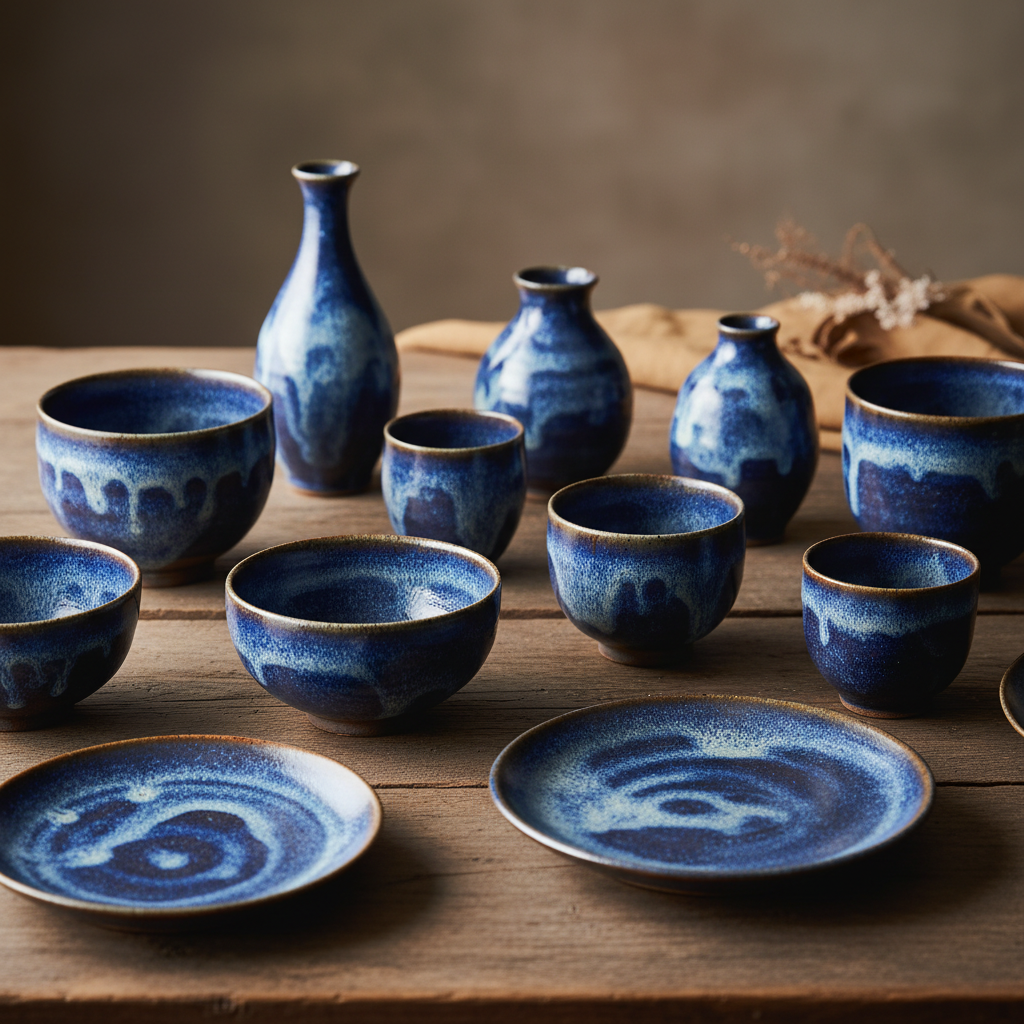
Naraoka Ware: The Charm and History of Akita Prefecture’s Traditional Ceramics, Featuring the Distinctive Namako Glaze
Naraoka ware (naraokayaki), fired in the Nanbo region of Daisen City in the southern inland areas of Akita Prefecture, is a traditional pottery representing Akita Prefecture with a history of over 160 years dating back to the late Edo period. It is highly acclaimed by many ceramicists and art critics as a masterwork that combines the beautiful blue-green gradation created by its distinctive namako glaze (sea-cucumber glaze) with practicality suitable for everyday use. This article provides a thorough explanation of the charm of this traditional craft, covering the history, characteristics, manufacturing techniques, and current state of the production area of Naraoka ware.
Naraoka Ware: An Overview of Akita Prefecture’s Traditional Pottery
Naraoka ware is pottery produced in the Nanbo region of Daisen City, Akita Prefecture (formerly Nan-Naraoka Village). Among the ceramics currently existing within Akita Prefecture, it possesses the oldest history and continues to preserve the tradition of being the prefecture’s oldest kiln to this day.
Basic Information about Naraoka Ware
- Production Area: Nanbo region, Daisen City, Akita Prefecture
- Year of Establishment: 1863 (Bunkyū 3)
- Type: Pottery
- Main Characteristics: Distinctive blue color from namako glaze
- Designation: Traditional Crafts of Akita Prefecture
Naraoka ware is produced using local soil and natural materials, with each piece handcrafted by artisans. The simple forms and beautiful colors of the namako glaze harmonize to create folk art that combines both “utility” and “beauty,” attracting many enthusiasts throughout Akita and beyond.
The History of Naraoka Ware: From the Late Edo Period to Present Day
The Beginning: Birth in 1863 (Bunkyū 3)
The history of Naraoka ware began in 1863 (Bunkyū 3) during the late Edo period. It is said to have originated when a local notable family member named Kommatsu Seiji invited a potter from Terauchi ware in Akita City to build a kiln. According to another account, it is said to have begun when artisans from Soma ware provided instruction in firing porcelain, suggesting the possibility of multiple origins.
Initially, the focus was on practical items needed in daily life, such as sake bottles, water jars, and grinding mortars. Because potters have continuously produced vessels closely connected to people’s lives, the functionality of the vessels is exceptionally high, and this practicality has become a major characteristic of Naraoka ware.
Development from the Meiji Period Onwards
Upon entering the Meiji period, Naraoka ware developed as an important regional industry. Despite its location in a mountainous village in the southern inland regions of Akita Prefecture, the beauty of its distinctive namako glaze gained a reputation and gradually became known throughout the prefecture and beyond.
During this period, Naraoka ware came to be recognized not merely as utilitarian goods, but also as crafts possessing artistic value. The contrast between the reddish-brown soil color and the deep blue-white namako glaze attracted the attention of many ceramicists and art critics.
Naraoka Ware in the Modern Era
Today, Naraoka ware is designated as a traditional craft of Akita Prefecture, and preservation and promotion efforts are being made as part of the “Handmade Akita” project. Centered around the Naraoka Pottery Studio in the Nanbo region of Daisen City, new product development suited to contemporary lifestyles is being conducted while preserving traditional techniques.
Of particular note is the adoption of the “Naraoka Ware Color” for the green car seats of the Akita Shinkansen “Komachi.” This is evidence that Naraoka ware’s distinctive blue color has been recognized as a color representing Akita, and has become a source of local pride.
The Greatest Characteristic of Naraoka Ware: The Beauty of Namako Glaze
What is Namako Glaze?
When discussing Naraoka ware, the distinctive glaze called namako glaze (sea-cucumber glaze) is indispensable. Namako glaze is a glaze that exhibits a blue-white color tone through chemical reactions during firing, and is called “namako glaze” because part of it resembles the namako, a marine creature (sea cucumber).
The characteristics of namako glaze are as follows:
- Color Diversity: Distinctive gradation that flows blue, white, and sometimes black
- Glossy Surface: A unique luster not seen in other ceramics
- Individual Variation: Even using the same glaze, each piece displays a different appearance depending on firing conditions
- Deep Color Tones: Beautiful color tones ranging from deep blue to pale blue
Manufacturing Technology of Namako Glaze
The production of namako glaze requires highly advanced techniques. The compounding of the glaze, temperature management of the kiln, firing time, and various other factors are intricately intertwined, and long years of experience and intuition are necessary to produce ideal colors.
In particular, the management of firing temperature is extremely difficult. To produce the distinctive blue color of namako glaze, firing must occur at an appropriate temperature, and even slight temperature differences significantly impact the final result. This technical difficulty increases both the rarity and value of Naraoka ware.
Contrast with Reddish-Brown Soil Color
Another aesthetic characteristic of Naraoka ware is the contrast created between the reddish-brown soil using natural materials from Akita and the blue-white color of the namako glaze. The warm earth tone appearing on unglazed portions and the cold, beautiful blue of the namako glaze create a striking contrast, producing a distinctive beauty.
This color contrast is one of the major reasons Naraoka ware is valued as a folk craft that combines both “utility” and “beauty.” While being everyday tableware, it also possesses value as an artistic work—this duality enhances the appeal of Naraoka ware.
The Manufacturing Process and Artisanal Skill of Naraoka Ware
Extraction of Raw Materials and Clay Preparation
The manufacture of Naraoka ware begins with the use of natural materials from the local Akita region. Clay extracted from the areas surrounding Daisen City’s Nanbo region is the primary raw material, to which various natural materials are added to create ceramic clay.
The clay preparation process:
- Clay Extraction: High-quality clay is extracted from local mountains
- Purification: Impurities are removed and particles are made uniform
- Compounding: Multiple clays are mixed to create ceramic clay with optimal plasticity
- Aging: Clay is left to rest to achieve a condition suitable for forming
Forming Technique
The forming of Naraoka ware centers primarily on traditional wheel-throwing techniques. Each piece is handcrafted by skilled artisans using traditional methods.
Main forming methods:
- Wheel Throwing: Round vessels such as bowls, plates, and mugs
- Hand-Building: Vessels with complex shapes and decorative pieces
- Mold-Forming: When producing multiple vessels of the same shape
The simple forms characteristic of Naraoka ware result from avoiding excessive decoration and prioritizing ease of use. This commitment to functionality produces the high level of practical utility that characterizes Naraoka ware.
Drying and Bisque Firing
After forming, vessels are thoroughly dried and then subjected to bisque firing. Bisque firing occurs at temperatures around 800 degrees Celsius, a process that gives vessels a certain degree of strength. After bisque firing, vessels become porous and readily absorb glaze.
Glazing: The Technique of Applying Namako Glaze
The most important process in Naraoka ware manufacture is glazing. The technique of applying namako glaze to vessels requires long years of experience and is a highly advanced skill.
Glazing methods:
- Dipping: Vessels are immersed in the glaze solution to apply glaze
- Pouring: Glaze is poured over vessels
- Spraying: Glaze is applied using a spray method
The final color and patterns after firing vary depending on how the glaze is applied. Artisans are well versed in how to apply it to achieve ideal results based on long years of experience.
Kiln Firing: The Most Difficult Process
After glazing, vessels are kiln-fired at temperatures exceeding 1200 degrees Celsius. This firing process is both the most difficult and the most important process in Naraoka ware manufacture.
Important points in firing:
- Temperature Control: Appropriate temperature setting to produce the distinctive blue color of namako glaze
- Heating Rate: Rapid temperature changes can cause vessel breakage or glaze defects
- Firing Duration: Sufficient time allows the glaze to develop its beautiful color
- Cooling: Slow cooling prevents vessel warping and glaze cracking
Temperature distribution and oxygen concentration within the kiln also affect the color development of namako glaze. Therefore, even using the same glaze, each vessel exhibits a different appearance. This individual variation is one of the appeals of handmade Naraoka ware.
Representative Products of Naraoka Ware
Everyday Practical Items
Naraoka ware originally centered on practical items closely connected to daily life, and many traditional products continue to be made today.
Grinding Mortar
One of the representative products of Naraoka ware. The fine ridges on the interior are designed to make grinding food easy. It is a masterpiece combining the beauty of namako glaze with practicality.
Sake Bottle and Sake Cup
Sake vessels are standard Naraoka ware products. The blue of the namako glaze enhances the clarity of sake and makes evening drinking a special occasion.
Water Jar
A traditional large-scale product. Once used in every household, it is now popular as a decorative piece or flower vase.
Contemporary Tableware
New products adapted to contemporary lifestyles are also being developed.
Mug
The morning glory-shaped mug is a contemporary representative work of Naraoka ware. Its easy-to-hold shape and the beauty of the namako glaze enrich daily coffee time.
Bowls and Plates
Rice bowls, soup bowls, and serving plates and other everyday tableware are fully stocked. The blue of the namako glaze adorns the dining table and beautifully complements cuisine.
Small Bowls and Small Plates
Small vessels for side dishes and condiments are also popular. Using multiple pieces together creates a sense of unity on the dining table.
Decorative and Fine Art Pieces
In addition to practical items, pieces for appreciation as fine art are also produced.
Flower Vases
Various sizes of flower vases are available, from single-flower vases to large flower arrangements. The blue of the namako glaze highlights the beauty of flowers.
Tea Ceremony Utensils
Tea bowls, water containers, and waste water basins for tea ceremonies are also produced. Highly valued by tea enthusiasts, artistically significant works are created.
The Naraoka Ware Production Area: Nanbo Region of Daisen City
Geography and Environment of the Production Area
The Nanbo region of Daisen City, the production area for Naraoka ware, is located in the mountainous areas of the southern inland regions of Akita Prefecture. This area, blessed with abundant nature, possesses high-quality clay and abundant water resources, making it an environment well-suited for ceramic production.
Located approximately one hour by car from Akita City and about 30 minutes from the center of Daisen City, artisans hone their traditional skills in the quiet environment of the surrounding mountains.
Naraoka Pottery Studio: The Central Facility Preserving Tradition
The center for Naraoka ware production and promotion is the Naraoka Pottery Studio. In addition to Naraoka ware production, exhibition and sales, and pottery experience programs are also conducted here.
Main activities of the Naraoka Pottery Studio:
- Production: Manufacturing of Naraoka ware using traditional techniques
- Exhibition and Sales: Display and sale of various Naraoka ware products
- Pottery Experience: Provision of wheel-throwing and design painting experiences
- Technical Succession: Training of young artisans and technical instruction
- Information Dissemination: Activities communicating the appeal of Naraoka ware widely
Pottery Experience: Making Naraoka Ware Yourself
The Naraoka Pottery Studio offers programs where the general public can experience the production of Naraoka ware. Various courses are available, including wheel-throwing experience and design painting on bisque-fired vessels.
Pieces created during the experience are finished by artisans in the subsequent processes (glazing and firing) and can be collected on-site or received by mail at a later date. Naraoka ware you create yourself holds special value as a memento of your trip.
It is recommended to contact the Naraoka Pottery Studio in advance regarding experience reservations and details.
Naraoka Ware and Akita Culture
Relationship with the Akita Shinkansen “Komachi”
Naraoka ware, as a traditional craft representing Akita, has also been adopted in the design of the Akita Shinkansen “Komachi.” The “Naraoka Ware Color” is used for green car seat colors, allowing passengers to enjoy their journey wrapped in the traditional colors of Akita.
This adoption is evidence that Naraoka ware’s distinctive blue color has been widely recognized as a color symbolizing Akita. The collaboration between the modern Shinkansen and traditional crafts symbolizes the fusion of tradition and innovation.
Relationship with Other Akita Ceramics
Akita Prefecture is home to several other traditional ceramics in addition to Naraoka ware.
Shiraiwa Ware
Pottery fired in Kakizaki Town, Semboku City, which alongside Naraoka ware represents Akita’s signature ceramics. Shiraiwa ware also uses namako glaze but possesses different characteristics from Naraoka ware.
Terauchi Ware
Ceramics fired in Akita City, said to have been involved in the founding of Naraoka ware. Though no longer in production, it is historically significant.
These ceramics have developed while influencing one another. Understanding the relationship between Naraoka ware and other Akita ceramics is important for comprehending Naraoka ware’s history.
Contribution to Regional Revitalization
Naraoka ware serves as an important regional resource for Daisen City’s Nanbo region, contributing to regional revitalization. It supports the local economy in various ways, including attracting tourists, establishing regional brands, and creating employment.
In recent years, initiatives for regional revitalization utilizing Naraoka ware have become increasingly active. New applications are being explored, such as food events pairing local ingredients with Naraoka ware vessels and the use of Naraoka ware as tableware in accommodations.
How to Purchase Naraoka Ware
Purchasing at the Production Site
The most reliable way to purchase Naraoka ware is to visit the Naraoka Pottery Studio in Daisen City’s Nanbo region. Here you can directly view and handle a variety of products. You can also speak directly with artisans, deepening your understanding of Naraoka ware.
Online Store
An online store is convenient for those living in distant locations. The official direct store allows various products to be purchased online. Detailed photographs and descriptions are provided, allowing you to obtain Naraoka ware from your home.
Retailers in Akita Prefecture
Naraoka ware is also handled in regional product centers and crafts shops throughout Akita Prefecture. Particularly in stores in Akita City handling “Traditional Crafts of Akita” and in facilities such as the Kakizaki Birch Bark Crafts Center, Naraoka ware products can be seen.
Exhibitions and Events
Naraoka ware is often sold at craft exhibitions and events held throughout the prefecture and nation. At “Handmade Akita”-related events, Naraoka ware is frequently introduced, so checking information is recommended.
How to Use and Care for Naraoka Ware
Preparation Before Initial Use
Simple preparation before first using Naraoka ware allows it to be used longer and more beautifully.
- Seasoning: Boiling in rice water fills the fine gaps in the pottery
- Rinsing: Thoroughly rinse before use
- Drying: Allow to dry completely before use
Daily Usage
Naraoka ware’s high practicality allows it to be used in daily life.
- Microwave: Usable, but avoid if metal decorations are present
- Dishwasher: Usable, but hand-washing extends longevity
- Oven: Heat-resistant, but avoid rapid temperature changes
Care Methods
Methods for maintaining Naraoka ware for long-term beautiful use:
- Wash Immediately After Use: Do not leave soiled items unattended
- Wash with Soft Sponge: Avoid sponges containing abrasives
- Allow Sufficient Drying: Store in locations with minimal moisture
- Pay Attention to Stacking: Place cloth between vessels so they do not directly touch
Handling Stains and Discoloration
With long use, stains such as tea discoloration may develop.
- Tea Stains: May be removed by gently rubbing with baking soda
- Discoloration: Avoid bleach as it may damage the glaze
- Cracks: Crazing (fine cracks) is a pottery characteristic and not problematic
The Current State and Challenges of Naraoka Ware
The Challenge of Training Successors
Like many traditional crafts, Naraoka ware faces the challenge of a shortage of successors. The namako glaze manufacturing technique is advanced and requires considerable time to master, making the training of young artisans an urgent matter.
Currently, the Naraoka Pottery Studio actively undertakes training efforts, working to both inherit traditional techniques and pursue new creative work with contemporary sensibilities.
Efforts to Expand Demand
Various initiatives are being undertaken to expand demand for Naraoka ware.
- Development of Contemporary Designs: Creating products acceptable to younger generations
- Strengthening Online Sales: Establishing environments where products can be purchased from anywhere in Japan
- Information Dissemination through Social Media: Communicating appeal through Instagram and Facebook
- Collaborations: Collaborations with local companies and other crafts
Balancing Innovation and Tradition
Efforts to introduce new technology while preserving tradition are also underway. Precise temperature control, research and development of glazes, and scientific approaches are being incorporated while maintaining the value of traditional handwork—a delicate balance is required.
Discovering Akita’s Appeal Through Naraoka Ware
Naraoka ware is not merely a ceramic but rather a craft work in which Akita’s history, culture, and nature are concentrated. The beautiful blue of the namako glaze evokes Akita’s sky and sea, while the simple forms express the upright character of Akita’s people.
Holding Naraoka ware means touching a tradition with over 160 years of history and feeling the skill and heart of the artisan. Whether as everyday tableware or as a fine art piece, Naraoka ware enriches our lives.
Should you have the opportunity to visit Akita, be sure to visit the Naraoka Pottery Studio in the Nanbo region of Daisen City. The Naraoka ware you encounter there will become an unforgettable memory of your Akita visit. Those living far away can also experience the appeal of Naraoka ware through the online store.
Through the traditional craft of Naraoka ware, we hope you will feel Akita’s deep culture and history. The blue of the namako glaze, displaying a different appearance in each piece, soothes the heart of the beholder and enriches the daily life of the user. Please, experience the world of Naraoka ware for yourself.
