Tokoname Ware: History and Characteristics of Aichi Prefecture’s Pottery Industry
Tokoname ware (tokonameyaki) is ceramic ware produced primarily in Tokoname City, located in the western part of the Chita Peninsula in Aichi Prefecture. Counted as one of Japan’s Six Ancient Kilns, it is known as one of Japan’s largest pottery production centers, continuing for over a thousand years from the late Heian period to the present day. Taking advantage of clay rich in iron content, it has produced diverse products over time, including vermillion clay teapots (shudei) and beckoning cats (maneki-neko) that have become a symbol of the town.
Tokoname City, with an area of 55.90 km² and a population of approximately 58,902 (as of February 2018), is blessed with a warm climate and has developed its pottery industry in an environment with an average temperature of 16.2°C and annual precipitation of 1,390 mm. Currently, there are 58 pottery businesses employing 1,511 people (as of December 2014); however, at its peak in December 1993, there were 435 businesses employing 9,291 people, making it a crucial hub supporting Japan’s ceramic industry.
History of Tokoname Ware
Origins in the Late Heian Period and Influence of the Sanage Kiln
The history of Tokoname ware traces back to the late Heian period, around the 12th century. Pottery production in this region began following the tradition of the Sanage kiln (sanageyou), which existed around Seto City in Aichi Prefecture. The Sanage kiln was a major pottery production center that flourished from the Nara through Heian periods, and when its techniques were transmitted to the Chita Peninsula, Tokoname ware was born.
Early Tokoname ware focused on producing articles called mountain tea bowls (yamachawan), simple everyday vessels. Mountain tea bowls were rustic ash-glazed bowls widely used as essential vessels in common people’s daily lives. During this period, numerous kilns were built in the hilly regions of the Chita Peninsula, and pottery production intensified.
Large Jar Production and Technical Innovation in the Kamakura Period
With the arrival of the Kamakura period, Tokoname ware entered a major turning point. During this time, production of large jars (kame) and storage vessels became prevalent in Tokoname. These containers for storing grains, water, miso, and soy sauce were in high demand not only among the nobility, temples, and warrior classes but also among common people.
A characteristic technique of Tokoname ware called “yoriko-zukuri” (coil-building) developed during this period. This method of shaping involved stacking clay coils to create large vessels, making it possible to efficiently mass-produce large jars and storage vessels that were difficult to create using only the potter’s wheel. This technical innovation made Tokoname the largest production center for jars and vessels in medieval Japan, with its products distributed throughout the country.
Establishment of Status as One of the Six Medieval Ancient Kilns
The “Six Ancient Kilns of Japan” (Roku Koji Yo), named by ceramics scholar Oyama Fujio, refers to representative pottery production centers that have continued from the medieval period to the present. Tokoname ware, as one of these six alongside Seto, Shigaraki, Tamba, Echizen, and Bizen, has supported Japan’s ceramic culture.
Of particular note is that Tokoname’s techniques exerted significant influence on other pottery centers. Famous production areas such as Shigaraki ware (Shiga Prefecture), Tamba ware (Hyogo Prefecture), and Echizen ware (Fukui Prefecture) developed by incorporating Tokoname’s techniques. Tokoname ware played not merely a regional role but served as a central point in the dissemination of Japan’s ceramic technology.
Diversification in the Edo Period and the Emergence of Vermillion Clay Teapots
With the Edo period came further diversification of Tokoname ware. As tea ceremony culture became more widespread during this era, demand for tea utensils increased. In Tokoname, taking advantage of the characteristics of clay rich in iron content found in the Chita Peninsula, artisans developed pottery called “vermillion clay” (shudei), a reddish-brown ware.
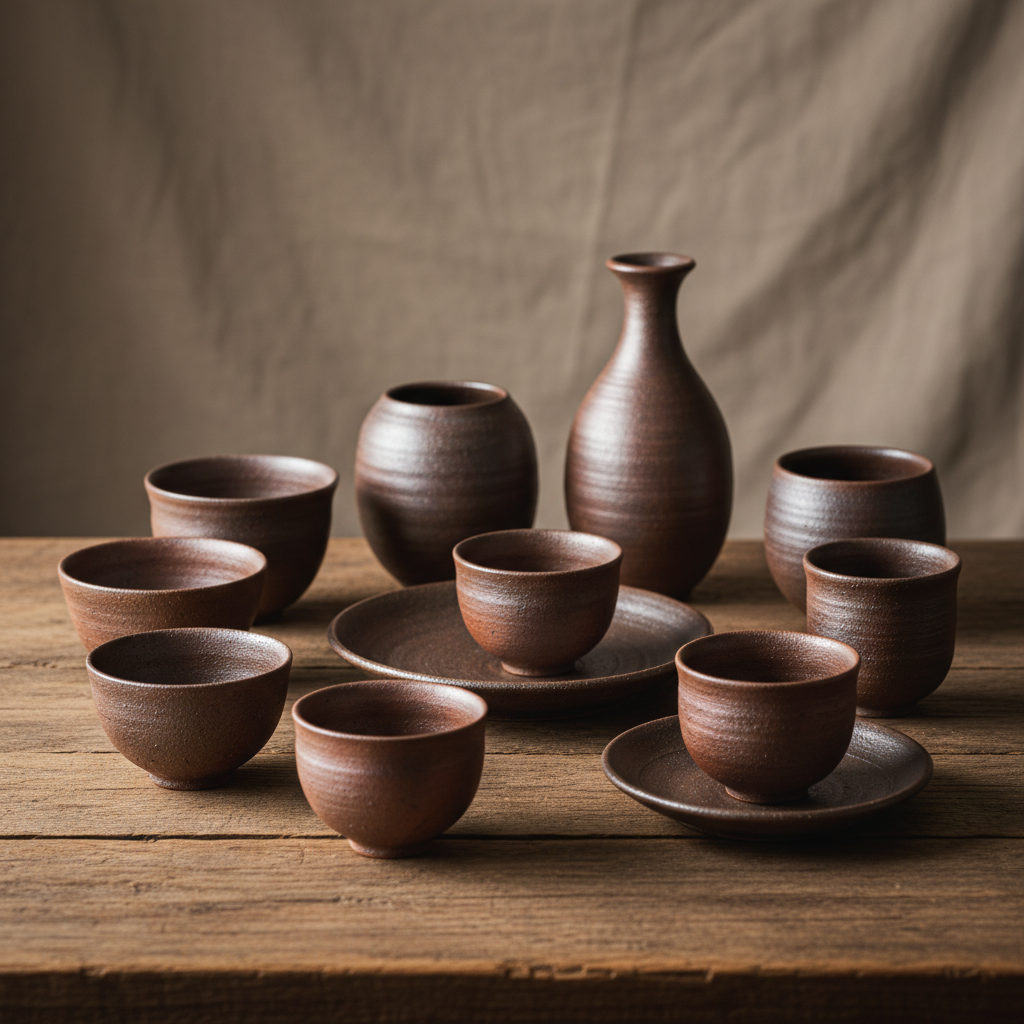
Vermillion clay teapots are made from iron-rich clay that develops a beautiful reddish-brown color through oxidation firing, achieving a dense texture through high-temperature firing without glaze application. These teapots were praised for bringing out the flavor of tea and became representative products of Tokoname ware. In the late Edo period, techniques from the Chinese Yixing kiln (gikōyō) were also incorporated, leading to more refined teapot production.
Modernization and Drainage Pipe Production from the Meiji Period Onward
With the arrival of the Meiji period, Tokoname ware rode the wave of modernization and developed significantly as an industry. Particularly from the mid-Meiji period through the early Showa period, large-scale production of drainage pipes, tiles, and sanitary ceramics for construction began.
Drainage pipes were essential products for sewer system installation and agricultural drainage, and demand surged with Japan’s modernization. Tokoname became Japan’s largest production center for drainage pipes and became known as the “town of drainage pipes.” At its peak, millions of pipes were produced annually and shipped nationwide.
During this period, numerous large coal-fired kilns and climbing kilns were built in Tokoname, and mass production systems were established. The pottery industry became the core industry of Tokoname, creating numerous jobs and serving as a pillar supporting the regional economy.
Contemporary Tokoname Ware and the Town of Beckoning Cats
From the late Showa period through the Heisei era, Tokoname ware entered another turning point. With declining demand for construction materials, drainage pipe production contracted, but traditional teapot production was revived and new ceramic art creation flourished.
What symbolizes contemporary Tokoname is the beckoning cat (maneki-neko). Tokoname is Japan’s largest producer of beckoning cats, with various cats, including the giant “Tokonya,” displayed throughout the town. As auspicious objects popular both domestically and internationally, beckoning cats have become a new face of Tokoname ware.
In 2017, Tokoname was recognized as a Japan Heritage site as “Surely to Fall in Love with Six Ancient Kilns – Pottery Production Centers Born and Raised in Japan,” attracting attention as a tourism resource.
Characteristics of Tokoname Ware
Utilization of Iron-Rich Clay
The greatest characteristic of Tokoname ware is its use of clay rich in iron content sourced from the Chita Peninsula. In conventional ceramic production, iron content in clay tends to cause blackening or bloating during firing, making it difficult to work with.
However, Tokoname ware succeeded in turning this weakness into an advantage, using the iron content in the clay to produce uniform reddish-brown ware. Through oxidation firing, the iron becomes iron oxide, producing beautiful coloring from vermillion to reddish-brown hues.
Yakijime (Hardening Through Firing) Technique
Another important characteristic of Tokoname ware is the “yakijime” (hardening through firing) technique. Yakijime involves firing clay at high temperatures (approximately 1200°C or higher) without glaze application, densely compacting the clay through firing.
This technique gives Tokoname ware the following excellent characteristics:
- High Strength: Through yakijime, clay particles bond tightly, creating extremely hard and durable vessels
- Low Water Absorption: The dense structure resists water permeation, making it suitable for liquid storage
- Natural Aesthetic: Without glaze, the original texture and color of the clay can be enjoyed
- Aging Characteristics: The more it is used, the more character it gains, developing a distinctive luster
Charm of Vermillion Clay Teapots
The vermillion clay teapot, a representative product of Tokoname ware, has several special characteristics.
Brings Out the Flavor of Tea: The components in vermillion clay are said to soften the astringency of tea, creating a mellow taste. Indeed, many people report that tea brewed in a Tokoname vermillion clay teapot becomes smoother.
Diverse Color Variations: Beyond vermillion clay, there are teapots in various colors including green clay (ryokudei), white clay (hakudei), and kiln-transformed teapots. Kiln-transformed teapots are made by refiring vermillion clay teapots with rice husks inside, creating unique coloring and patterns.
Precise Forming: Careful forming through wheel-throwing or hand-building, refined finishing of spouts and handles, and other elements showcase the high skill of craftspeople.
Diverse Product Range
Over its thousand-year history, Tokoname ware has produced diverse products in response to the needs of different eras.
- Old Tokoname: Jars, storage vessels, and mountain tea bowls from the Heian through Muromachi periods
- Tea Utensils: Teapots, tea bowls, water containers, flower vases
- Daily Vessels: Plates, bowls, tea cups, sake bottles
- Construction Ceramics: Drainage pipes, tiles, sanitary ceramics
- Auspicious Objects: Beckoning cats, guardian lions, ornaments
- Contemporary Ceramics: Art pieces and objets d’art
This diversity is one reason Tokoname ware has continued for over a thousand years.
Reason for Thousand-Year Continuity ①: Suitable Clay from Hilly Terrain
The first reason Tokoname ware has continued for over a thousand years is that the region was blessed with geographic conditions yielding abundant high-quality pottery clay.
The hilly regions of the Chita Peninsula contain widespread clay deposits suitable for ceramic production. This clay possesses appropriate plasticity (ease of forming) and stable shrinkage rates after firing, enabling diverse forming from large products to precise teapots.
The hilly terrain was also ideal for kiln construction. Climbing kilns built on slopes could efficiently achieve high temperatures utilizing natural draft, enabling mass production.
Pine wood for fuel was readily available from surrounding forests, and the fortunate circumstance of having both raw materials and fuel sourced locally supported the continuous development of the pottery industry.
Reason for Thousand-Year Continuity ②: Availability of Water Routes and Cargo Vessels
The second factor supporting Tokoname ware’s development was its excellent distribution network.
The Chita Peninsula is surrounded by sea on three sides, and Tokoname in particular was a port town facing Ise Bay. During the Edo period, cargo vessels called kaisen (merchant ships) actively traveled these waters, with Tokoname ware products distributed nationwide via sea routes.
For transporting large quantities of heavy, bulky ceramic products, maritime routes were far more efficient than land routes. Tokoname’s jars and storage vessels were delivered by ship to markets throughout the country—Edo (Tokyo), Osaka (Kyoto), Kyushu, the Tohoku region—meeting broad-based demand.
Moreover, water routes and canals were developed within the Chita Peninsula, allowing smooth transport of products from inland kiln sites to the port. This logistics advantage was a crucial factor that elevated Tokoname to Japan’s largest pottery production center.
Reason for Thousand-Year Continuity ③: Continuous Production Adapting to Changing Times
The most important reason Tokoname ware has continued for over a thousand years is its flexible response to the needs of different eras and continuous creation of new products.
From mountain tea bowls in the late Heian period, to large jars in the Kamakura period, to vermillion clay teapots in the Edo period, to drainage pipes in the Meiji period, and to beckoning cats and art pieces in the contemporary period, the main products changed with the times.
Behind this flexibility lay the technical skill and spirit of inquiry of Tokoname’s craftspeople. They actively engaged in developing new techniques and products, eagerly learning techniques from other production centers. Whether incorporating techniques from China’s Yixing kiln in teapot production or introducing Western modern technology in drainage pipe production, they continually pursued the cutting edge of their era.
The cooperative system throughout the production area was also important. While individual kilns competed, shared technological information and joint sales channel development, along with the production area’s cohesion, supported Tokoname ware’s continuous development.
A Production Center with Rich Technology—The Largest of the Six Ancient Kilns
Tokoname ware is known as the largest production center among Japan’s Six Ancient Kilns. Its scale stands out not only in production volume but also in technological diversity.
Varied Forming Techniques
Tokoname’s craftspeople employ various forming techniques.
- Wheel-throwing: Traditional technique of forming clay on a rotating wheel
- Yoriko-zukuri: Technique of creating large vessels by stacking clay coils
- Tatara forming: Technique of forming by combining clay sheets
- Hand-building: Technique of directly forming clay by hand
- Slip-casting: Mass production technique of pouring slip into plaster molds
These techniques are applied according to product characteristics, or combined, to produce diverse products.
Evolution of Firing Technology
Tokoname also possesses rich accumulated knowledge in firing technology.
From traditional climbing kilns and coal-fired kilns to contemporary gas kilns and electric kilns, various kilns are used. Understanding the characteristics of each kiln and selecting optimal firing methods for different products represents knowledge and experience passed down through generations.
Particularly, firing vermillion clay teapots requires advanced technique. Temperature management, control of atmosphere (oxidation/reduction), and adjustment of cooling speed all significantly affect the product’s color and texture. The craftsperson’s intuition and skill, cultivated through years of experience, produces the beautiful vermillion color.
Diversity of Decorative Techniques
While yakijime is fundamental to Tokoname ware, decorative techniques are also diverse.
- Carving: Technique of engraving patterns or images into the surface
- Inlay: Technique of embedding clay of different colors
- Underglaze Painting: Technique of applying slip of different colors to the surface
- Kiln Transformation: Accidental color effects from chemical reactions during firing
- Glazing: Some products also use glaze application
By combining these techniques, a broad range of expression becomes possible, from simple yakijime to ornate decorative pieces.
Contemporary Tokoname Ware and Its Future
Coexistence of Tradition and Innovation
In contemporary Tokoname, traditional teapot artisans and young ceramic artists pursuing new expression coexist.
Traditional vermillion clay teapot techniques are highly valued as “Tokoname ware teapots,” enjoying support from tea ceremony enthusiasts and collectors. Meanwhile, contemporary-style tableware and ceramic art pieces represent active expansion into new fields.
Connection with Tourism Industry
Tokoname City has developed the “Pottery Walking Path” to communicate Tokoname ware’s appeal as a tourism resource.
The townscape with remaining old kilns and smokestacks creates a unique landscape, attracting numerous domestic and international visitors. Facilities where visitors can experience Tokoname ware—including pottery workshops at kilns, gallery tours, and the beckoning cat museum—are well-equipped.
The opening of Chubu Centrair International Airport in Tokoname City has greatly contributed to tourism promotion. Taking advantage of the location just minutes by train from the airport to downtown Tokoname, development as an international tourism destination is anticipated.
Successor Development and Technical Transmission
Cultivating human resources to carry Tokoname ware into the future is an important issue.
Aichi Prefectural Tokoname High School has a Ceramic Arts Division providing foundational ceramic training to young generations. Additionally, the Tokoname City Ceramic Research Institute offers more specialized technical learning.
The transmission of techniques from veteran craftspeople to younger artisans also actively occurs at individual kilns. By preserving traditional techniques while developing products suited to contemporary lifestyles, Tokoname ware moves forward into a new era.
International Expansion and Global Recognition
In recent years, Tokoname ware has attracted attention internationally.
Against the backdrop of a Japanese tea boom, interest in Tokoname teapots has grown in Western and Asian markets. Additionally, Tokoname tableware with its simple, refined design has been praised at international ceramic exhibitions.
With Japan Heritage designation, Tokoname ware’s cultural value is gaining international recognition, and further development is anticipated.
Conclusion
Tokoname ware is a representative ceramic production center of Japan with over a thousand years of continuous tradition on the Chita Peninsula in Aichi Prefecture. Beginning in the late Heian period by inheriting techniques from the Sanage kiln, it developed through large jar production in the Kamakura period, vermillion clay teapots in the Edo period, and drainage pipe production in the Meiji period, changing its main products with the times.
As one of Japan’s Six Ancient Kilns, it exerted technical influence on pottery centers including Shigaraki, Tamba, and Echizen, playing a central role in Japan’s ceramic culture. The beauty of vermillion clay utilizing iron-rich clay, the dense texture achieved through yakijime firing, and flexible product development responding to era-specific needs characterize Tokoname ware.
High-quality pottery clay, an excellent distribution network, and most importantly, the technical skill and spirit of inquiry of craftspeople continuously adapting to changing times have sustained Tokoname ware’s history spanning over a thousand years. Today, producing diverse products from traditional teapot craftsmanship to contemporary ceramics and beckoning cats, it attracts attention as a tourism resource.
Tokoname ware, embodying the richness of Japan’s ceramic culture, will continue its development into the future.