
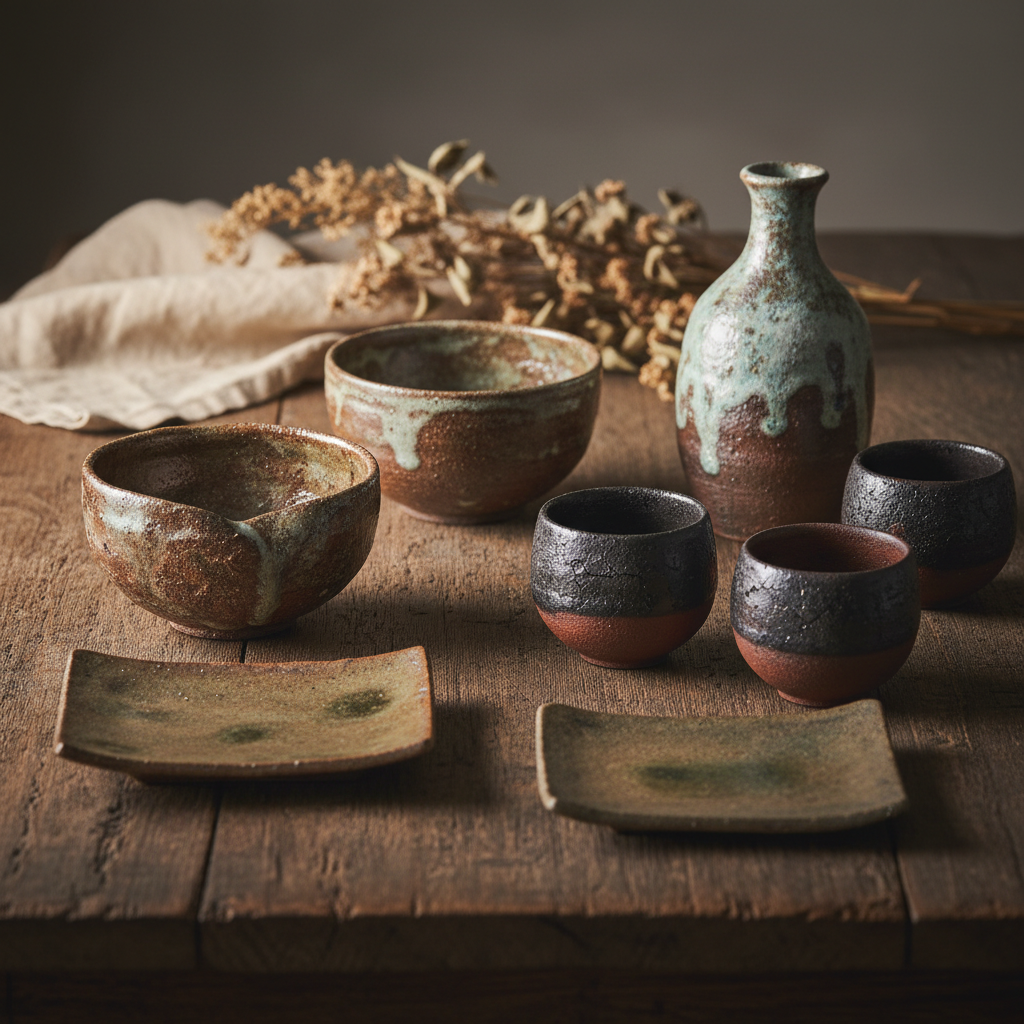
Rihei Ware: The Complete Picture of a Ceramic Production Center with a 400-Year Tradition Boasting Takamatsu, Kagawa Prefecture
What is Rihei Ware?
Rihei ware (rihei-yaki) is pottery fired in Takamatsu, Kagawa Prefecture, and is also called Takamatsu ware. This pottery has a particularly unique history among Japan’s ceramic production centers, and is a precious traditional craft that has been passed down for approximately 400 years through direct transmission from parent to child.
Currently, Rihei ware, with its kiln located in front of the north gate of Ritsurin Park, is designated as a traditional craft of the prefecture along with Okamoto ware, Kankake ware, and Omaya ware, as a ceramic representative of Kagawa Prefecture. However, unlike other production centers where numerous kilns are concentrated, the greatest characteristic is that it has been protected by a single family successive heirs who have inherited the name “Kita Rihei” through the generations.
History and Origins of Rihei Ware
Opening of the Oyaniwa (Garden Ware) by Matsudaira Yorishige, First Lord of Takamatsu
The history of Rihei ware dates back to 1649 (Keian 2) in the early Edo period. Matsudaira Yorishige, the first lord of Takamatsu, was the older brother of Tokugawa Mitsukuni, known as Mito Komon, and possessed deep knowledge of culture and the arts.
Matsudaira Yorishige invited the potter Morishima Sakubei Shigeri from Kyoto to Takamatsu and granted him land near the north gate of Ritsurin Park. This marked the beginning of Rihei ware. Oyaniwa refers to pottery fired under the patronage of the feudal lord, primarily made as official ware for the clan and tea utensils.
From Morishima Sakubei to Kita Rihei
Morishima Sakubei, a potter from Awata in Kyoto, changed his name to “Kita Riheiji” after settling in Takamatsu. This name became the origin of “Riheiji ware,” and later the notation “Rihei ware” became established.
The first Kita Riheiji brought Kyoto pottery techniques to Takamatsu and produced excellent works centered on colored-enamel pottery. This technique and spirit have been passed down through the generations and continue to the present day as the name of “Kita Rihei.”
The Tradition of Direct Parent-to-Child Transmission
The most distinctive feature of Rihei ware is that its techniques have been passed down through direct parent-to-child transmission. In contrast to many ceramic production centers that developed through multiple kilns, Rihei ware has been protected by a single family.
This tradition has sometimes brought difficulties. When predecessors passed away, such as when the previous master’s wife inherited the 14th generation Rihei position, the tradition has continued unbroken through family bonds. Currently, Kita Yoko maintains the kiln and transmits the traditional techniques to the present day.
Characteristics and Techniques of Rihei Ware
Colored-Enamel Pottery in the Kyoto Style
The greatest characteristic of Rihei ware lies in its colored-enamel pottery following the Kyoto pottery tradition. Because the first master was a potter invited from Kyoto, the refined techniques of Kyoto took root in the land of Takamatsu.
Colored-enamel is a technique in which patterns are drawn with overglaze on the white body after firing, and then the piece is fired again. Rihei ware is characterized by delicate brushwork depicting floral designs and geometric patterns, with an elegant and refined style passed down through the generations.
The Tradition as a Tea Ware Specialist Kiln
Rihei ware is known as a tea ware specialist kiln, primarily producing tea utensils. Various implements used in tea ceremony, including tea bowls, water vessels, flower containers, and incense holders, have been created, and their high quality has been treasured by tea practitioners.
Because of its origins as garden ware, both practicality and artistry are emphasized, and careful workmanship is applied to each piece. Currently, while centering on tea utensils, everyday ware is also being produced.
Painted Decoration Techniques
The painted decoration of Rihei ware is supported by highly developed techniques cultivated over many years. From preliminary sketching to final painting, skilled technique is required, and this includes secret techniques passed down through direct parent-to-child transmission.
Color selection, brushwork, adjustment of firing temperature—all processes require experience and artistic sensibility. This painted decoration technique is the important element that distinguishes Rihei ware from other ceramics.
Positioning of Rihei Ware as a Ceramic Production Center in Kagawa Prefecture
Ceramic Production Centers in Kagawa Prefecture
Kagawa Prefecture is not known as a large-scale ceramic production center, but there are several types of pottery with unique histories and characteristics. In addition to Rihei ware, Okamoto ware, Kankake ware, and Omaya ware are recognized as traditional crafts of Kagawa Prefecture.
These wares, unlike major production centers such as Arita ware and Bizen ware, are small in scale but possess unique individuality and have developed closely tied to regional culture.
The Uniqueness of Rihei Ware among Japan’s Ceramic Production Centers
Throughout Japan, there exist numerous famous ceramic production centers including Mino ware, Seto ware, Arita ware, Bizen ware, Kutani ware, Banko ware, Karatsu ware, Satsuma ware, and Kiyomizu ware. Most of these have developed as industries with multiple kilns gathered together.
However, Rihei ware is unique among Japan’s ceramic production centers in that it has employed a distinctive method of transmission called direct parent-to-child inheritance by a single family. It might be more accurate to describe it as a single kiln that has continued for nearly 400 years rather than as a production center.
This uniqueness enhances the rarity and value of Rihei ware, and it is highly evaluated as antiques and vintage items.
The Connection between Ritsurin Park and Rihei Ware
The Kiln in Front of the North Gate of Ritsurin Park
The current Rihei ware kiln is located at 34-17 Nakano-cho, Takamatsu, Kagawa Prefecture, in front of the north gate of Ritsurin Park. Ritsurin Park is designated as a national special place of scenic beauty and is one of Japan’s finest daimyo gardens, developed as the garden of the Takamatsu lord.
It is no coincidence that the Rihei ware kiln is in this location. It began when the first lord of Takamatsu, Matsudaira Yorishige, granted this land to Morishima Sakubei, and the fact that official pottery was fired in a location near the lord’s garden symbolizes the character of garden ware.
Takamatsu Culture and Rihei Ware
The area surrounding Ritsurin Park is also the center of Takamatsu’s culture. Rihei ware has developed while remaining closely connected to the history and culture of this region.
For tourists visiting Takamatsu, visiting the Rihei ware kiln in conjunction with viewing Ritsurin Park offers a valuable opportunity to deeply understand Kagawa’s traditional culture. The beautiful scenery of the park and the beauty of ceramics created by traditional techniques together form Takamatsu’s cultural appeal.
The Manufacturing Process of Rihei Ware
Preparation of Clay
The manufacture of Rihei ware begins with the selection of high-quality ceramic clay. Clay suitable for pottery is selected, impurities are removed, and it is thoroughly kneaded to achieve a state suitable for forming.
The condition of the clay greatly affects the quality of the finished work, so careful preparation based on long years of experience is essential.
Forming
Forming using a potter’s wheel is the process where the potter’s skill is most evident. Tea utensils such as tea bowls and water vessels are particularly valued for the beauty of their form, so skilled technique is required.
In the process of hand-forming each piece, the maker’s sensibility and technique are reflected in the work.
Bisque Firing
After the formed vessel is dried, bisque firing is performed at approximately 800 degrees. Through bisque firing, the vessel hardens and becomes easier to decorate in the next process.
Preliminary Sketch and Glaze
A preliminary sketch is applied to the bisque-fired vessel, and glaze is applied. In Rihei ware, delicate decoration following Kyoto pottery traditions is characteristic, and particular time and technique are devoted to this process.
Main Firing
Main firing is performed at temperatures exceeding 1200 degrees. In this process, the glaze transforms into a glass-like substance and develops a beautiful luster. Temperature control is an important factor affecting the quality of the piece.
Overglaze Decoration and Firing
In the case of colored-enamel pottery, patterns are painted with overglaze after main firing, and the piece is fired at approximately 800 degrees. Through this process, the vivid colors distinctive to Rihei ware become fixed.
Present-Day Rihei Ware and Its Successors
The Continuation of Tradition by Kita Yoko
Currently, the Rihei ware kiln is maintained by Kita Yoko. After the passing of the previous master, she inherited the kiln to prevent the tradition from being lost, transmitting the techniques and spirit of Rihei ware, which has continued for nearly 400 years, to the present day.
The succession of a woman to the name “Kita Rihei” is a rare case in the traditional form of direct parent-to-child transmission, but all the more so it reflects the strong determination and resolve to continue protecting Rihei ware.
Recognition as a Traditional Craft
Rihei ware is officially recognized as a traditional craft of Kagawa Prefecture and is introduced in the prefecture’s “Kagawa Mono” project. This demonstrates that Rihei ware is not merely a historical heritage but a living traditional craft that continues to be active today.
Challenges and Outlook for Rihei Ware in the Modern Era
The traditional method of direct parent-to-child transmission, while preserving the purity of technique, also carries the challenge of finding successors. Currently, there is a demand for creating works that respond to contemporary needs while preserving tradition.
By continuing to center on tea utensils while also challenging everyday ware and contemporary design, new possibilities for Rihei ware are being explored.
Appreciating and Obtaining Rihei Ware
Purchase at the Kiln
The most reliable way to obtain Rihei ware is to directly visit the kiln in Nakano-cho, Takamatsu. Given its convenient location in front of the north gate of Ritsurin Park, one can stop by while sightseeing.
At the kiln, one can directly view the works and select them while hearing about the maker’s intentions.
Rihei Ware as Antiques and Vintage Items
Older Rihei ware also appears on the antique and vintage goods market. Works from the Edo and Meiji periods in particular are highly valued for their historical worth and are treasured as tea utensils.
They are sometimes handled in antique shops and curio dealers in Kyoto, and receive high evaluation among collectors.
Exhibitions and Events
Museums and craft halls in Kagawa Prefecture occasionally hold exhibitions of traditional crafts, including Rihei ware. By taking advantage of such opportunities, one can learn deeply about the history and techniques of Rihei ware.
Rihei Ware and Other Ceramics of Kagawa Prefecture
Okamoto Ware
Okamoto ware is pottery fired in the Okamoto district of Takamatsu. Like Rihei ware, it is designated as a traditional craft of Kagawa Prefecture, and each has its own unique characteristics.
Kankake Ware
Kankake ware is also one of Kagawa’s traditional ceramics. These types of pottery are closely tied to the culture of the region and have developed accordingly.
Omaya Ware
Including Omaya ware, Kagawa Prefecture possesses several traditional ceramics. Each has a different history and characteristics, demonstrating the diversity of Kagawa’s ceramic culture.
A Journey to Rihei Ware
Access Information
The Rihei ware kiln is located approximately 15 minutes by car from JR Takamatsu Station and about a 10-minute walk from Ritsurin Park Station. It is convenient to visit it together with sightseeing at Ritsurin Park.
Attractions Around Ritsurin Park
Ritsurin Park is a daimyo garden whose construction began in the early Edo period and is designated as a national special place of scenic beauty. Visitors can enjoy beautiful scenery throughout the four seasons, and it is Takamatsu’s representative tourist spot.
There is a tea room within the park, and tea gatherings using tea utensils made with Rihei ware are sometimes held.
Craft Culture in Takamatsu City
Besides Rihei ware, Takamatsu has traditional crafts such as Kagawa lacquerware and Aiji stone. By exploring the city, one can experience the rich craft culture of Kagawa Prefecture.
The Cultural Significance of Rihei Ware
The Tradition of Garden Ware
Rihei ware is a precious existence that transmits the Japanese tradition of garden ware to the present day. Garden ware that developed under the patronage of feudal lords is a special pottery combining practicality and artistry and holds an important position in the history of Japanese ceramics.
The Method of Direct Parent-to-Child Transmission
The fact that techniques have been passed down for nearly 400 years through direct parent-to-child transmission demonstrates one model of the transmission methods of Japanese traditional crafts. The tradition maintained by family bonds and strong sense of mission offers valuable insights when considering how to approach cultural transmission in the modern era.
Connection to Regional Culture
Rihei ware is deeply connected to the history and culture of the Takamatsu region. Its association with the Matsudaira family, its positional relationship to Ritsurin Park, and its connection to tea culture are important elements forming the cultural identity of the region.
Conclusion: The Future of Rihei Ware
Rihei ware is a traditional pottery that has continued for nearly 400 years in Takamatsu, Kagawa Prefecture, originating from garden ware founded by Morishima Sakubei (later Kita Riheiji), a potter invited from Kyoto by Matsudaira Yorishige, the first lord of Takamatsu. The techniques and spirit passed down through direct parent-to-child transmission are still protected at a kiln in front of the north gate of Ritsurin Park.
Rihei ware possesses many characteristics including colored-enamel pottery in the Kyoto style, the tradition of being a tea ware specialist kiln, and delicate painted decoration techniques, occupying a unique position among Japan’s ceramic production centers. Though not a large-scale production center, its rarity and high quality have made it treasured by tea practitioners and ceramic enthusiasts.
Currently inherited by Kita Yoko, Rihei ware is challenging the creation of works that respond to modern needs while preserving tradition. Though it faces challenges such as the succession problem, the techniques and spirit cultivated through 400 years of history will surely continue to be passed down as a precious cultural heritage of Kagawa Prefecture.
When visiting Takamatsu, why not visit the Rihei ware kiln together with enjoying the beautiful scenery of Ritsurin Park and appreciate the beautiful ceramics created by traditional techniques. There you will be able to feel the essence of Japanese ceramic culture passed down across 400 years of time.
