What is Komatsuhara Ware? The Complete Picture of a Ceramic Production Area with 400 Years of History Boasted by Miyazaki Prefecture
In a quiet residential area of Tsukimigaoka, Miyazaki City, Miyazaki Prefecture, there exists a traditional kiln that boasts a history of over 400 years. That is Komatsuhara Ware. This ceramic ware, which follows the tradition of Satsuma ware, is known for its unique techniques and beautiful glaze expressions, and has been passed down to the present day as a traditional craft of Miyazaki Prefecture. This article provides a detailed explanation of Komatsuhara Ware, covering its history, characteristics, manufacturing techniques, and contemporary initiatives, thoroughly exploring this precious ceramic production area.
History and Origins of Komatsuhara Ware
The Beginning by Korean Potters and Its Relationship with Satsuma Ware
The history of Komatsuhara Ware traces back to the late 16th century, to the Bunroku and Keicho campaigns. Potters who came from Korea began making pottery in Kagoshima, which is the origin of the craft. In particular, it inherits the tradition of Satsuma Ware, specifically the prestigious Naeshirogawa Ware, and carries on its techniques and traditions strongly.
The first potter opened a kiln in Kagoshima and engaged in ceramic production under the protection of the Satsuma Domain. The techniques cultivated during this era were passed down through generations and became the foundation of Komatsuhara Ware. The deep relationship with Satsuma Ware is still strongly reflected in Komatsuhara Ware’s techniques and aesthetic sense, occupying an important position in Kyushu’s ceramic culture.
Transfer to Komatsuhara Town, Miyakonojo City, and Development
In 1852 (Kaei 5), a pottery manufacturing facility was officially opened. Then, in 1860 (Man’en 1), the kiln was relocated to Komatsuhara Town in Miyakonojo City. The name “Komatsuhara Ware” was born from this place name.
The kiln at that time was located near the west side of Shinbashira Shrine in Komatsuhara Town, Miyakonojo City, in the area of the present-day Shinbashira Park Loyalty Monument Square. This location was included in Marumaru Village, and there was reportedly a “Matsubara Tea House” in the vicinity. The flourishing of pottery production in Komatsuhara was due to the existence of high-quality pottery clay and favorable location conditions as a traffic hub.
During the Miyakonojo era, Komatsuhara Ware was widely used as everyday household items for the region and was also treasured as a gift. Potters centered around the Bak family (bokke) passed down techniques through generations and developed their own unique methods.
Wartime Interruption and Showa-era Revival
The impact of World War II caused Komatsuhara Ware to cease production temporarily. During the wartime shortage of materials, conscription of craftspeople, and the confusion of the postwar period, it was extremely difficult to continue traditional pottery production.
However, between 1969 (Showa 44) and 1971 (Showa 46), Komatsuhara Ware was revived in Tsukimigaoka, Miyazaki City. This revival was realized through the efforts of local people wishing to preserve and pass on traditional techniques and craftspeople who had inherited the skills.
At present, at the kiln in Tsukimigaoka, Miyazaki City, the 14th and 15th generation craftspeople continue to keep the traditional flame alive. While researching prewar techniques and reviving techniques that were nearly lost, they are also working on creating pieces suited to modern life.
Characteristics and Techniques of Komatsuhara Ware
Unique Surface Finishing Techniques
The greatest characteristic of Komatsuhara Ware lies in its unique surface finishing technique. The following are representative examples:
Samehada (shark skin): As the name suggests, this technique expresses a texture with fine irregularities like sharkskin. This texture is created through special tools and methods, producing a unique tactile feel when touched and visual beauty.
Donkouhadā (tortoise shell texture): A technique expressing patterns like a turtle shell, which has a natural beauty while being regular. This technique requires advanced skills and can only be realized by skilled craftspeople.
Jakatsu (serpent scale): A traditional technique expressing patterns like snake scales, and one of the secret techniques passed down through generations in the Bak family. By making fine cuts in regular patterns, unique light reflection and shadow are created.
Tataki (beating): A technique of shaping clay by beating, which increases the strength of the vessel while giving its surface a unique texture. This technique strongly retains the tradition of Korean ceramics.
Carefully Researched Glaze Application
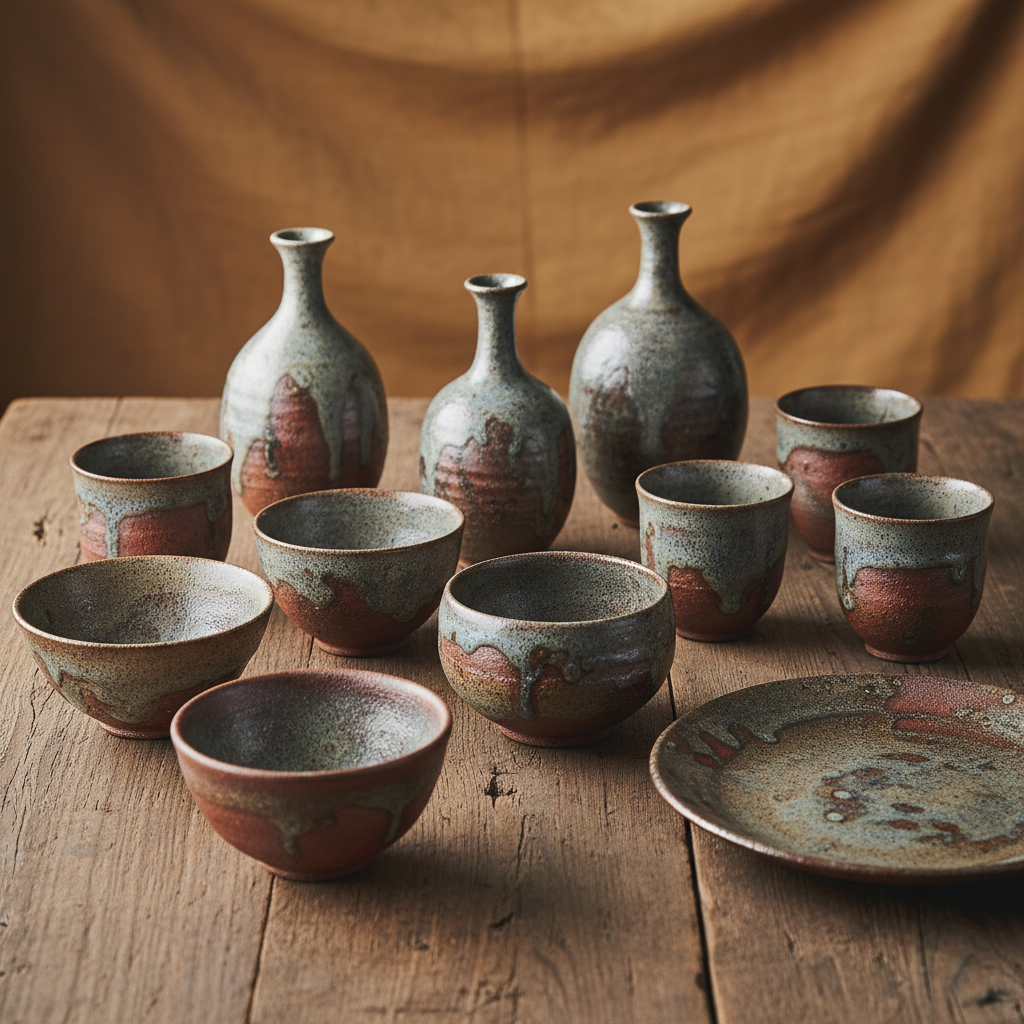
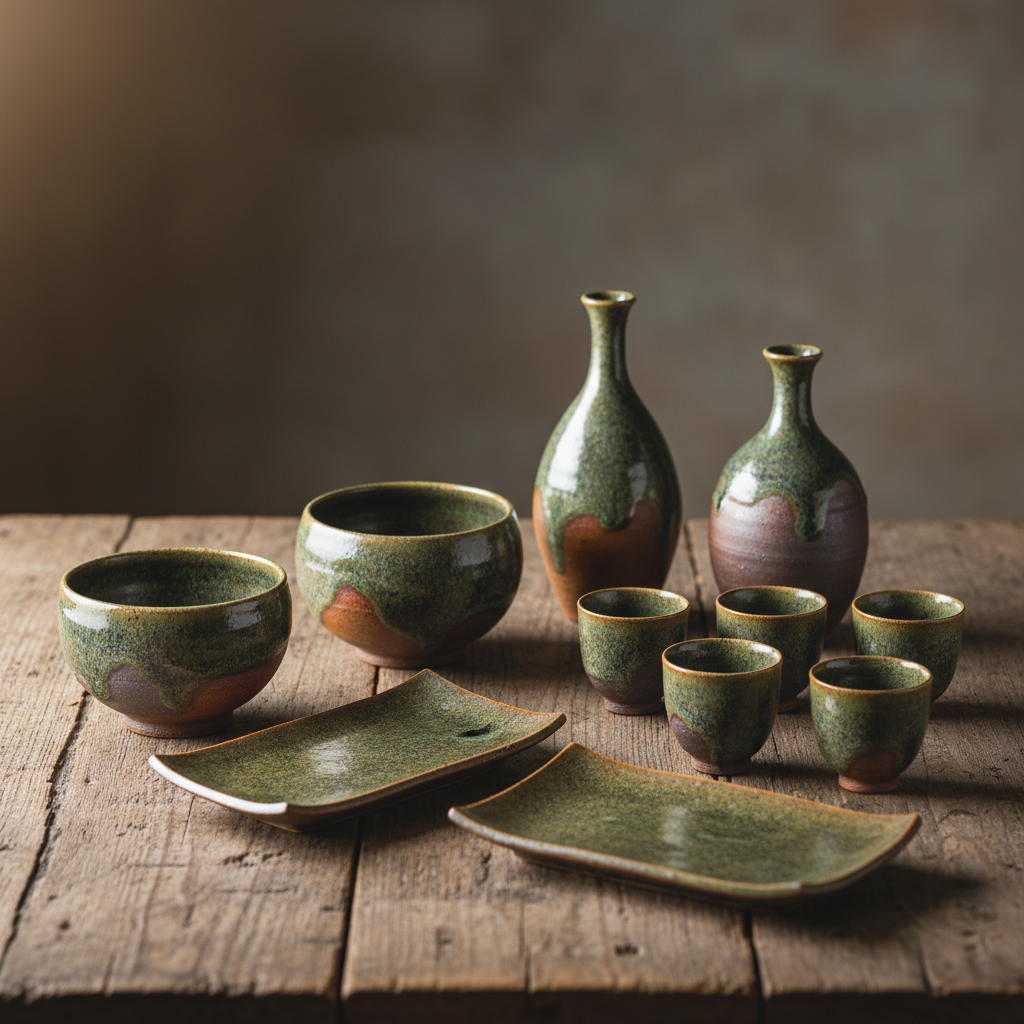
Another major characteristic of Komatsuhara Ware is its carefully researched use of glazes (yuuyaku). Craftspeople including Bak Pyeong-ui (朴平意), the 15th generation, have pursued color expressions suited to contemporary sensibilities while maintaining traditional glaze compositions.
The glaze blending often makes use of local materials, producing colors unique to the Miyazaki region. The subtle changes in the glaze’s appearance depending on firing temperature and position within the kiln give each piece an individuality that cannot be duplicated.
By using different glazes such as ash glaze, iron glaze, and white glaze, and sometimes layering multiple glazes, deep color expression is achieved. In particular, the black Satsuma technique inheriting the Satsuma Ware tradition has become an important characteristic of Komatsuhara Ware.
Technology Transmission by Traditional Craft Artisans
Bak Pyeong-ui (朴平意), the 15th generation, is certified as a Miyazaki Prefecture Traditional Craft Artisan and plays an important role in conveying the Bak family’s traditional techniques to the present day. Also, Tanaka Hakuzan and Tanzan, brothers of the 14th generation, continue to maintain the kiln’s fire while each utilizing their own individuality.
These craftspeople do not merely preserve tradition but also challenge themselves to create works suited to modern lifestyles. Creating works of various purposes such as tea ceremony implements, flower containers, and tableware, they pursue usability and design while utilizing traditional techniques.
Positioning as a Ceramic Production Area in Miyazaki Prefecture
Designation as Miyazaki Prefecture’s Traditional Craft
Komatsuhara Ware is designated as a traditional craft of Miyazaki Prefecture. This designation recognizes its history spanning over 400 years, unique techniques, and traditional manufacturing methods that have been inherited to the present day.
In addition to Komatsuhara Ware, other ceramics such as Hyuga Ware exist within Miyazaki Prefecture, but Komatsuhara Ware is particularly characterized by its historical connection with Satsuma Ware and unique surface finishing techniques unparalleled elsewhere.
The designation as a prefectural traditional craft provides support for technology transmission and cooperation in public relations activities, contributing to increased awareness of Komatsuhara Ware and cultivation of successors.
Context of Ceramic Production Areas in the Kyushu Region
The Kyushu region is an area where some of Japan’s most important ceramic production areas are concentrated. Arita Ware, Imari Ware, Karatsu Ware in Saga Prefecture, Ueno Ware and Takatori Ware in Fukuoka Prefecture, Hasami Ware in Nagasaki Prefecture, Aso Ware and Amakusa Ceramics in Kumamoto Prefecture, Onta Ware in Oita Prefecture, Satsuma Ware and Tanegashima Ware in Kagoshima Prefecture, each production area has its own characteristics.
In this context, Komatsuhara Ware occupies a unique position as a production area that has undergone independent development in Miyazaki Prefecture while inheriting the tradition of Satsuma Ware. In particular, the historical progression of its transfer from Miyakonojo to Miyazaki City and its revival is a characteristic not seen in other production areas.
Kyushu’s ceramic culture, based on the techniques of Korean potters, has undergone diverse development depending on each region’s raw materials, climate, and cultural background. Komatsuhara Ware plays a role in this, becoming an important element of Miyazaki Prefecture’s cultural identity.
Comparison with Ceramic Production Areas Nationwide
Numerous ceramic production areas exist throughout Japan, from Hokkaido to Okinawa.
In the Hokkaido region, relatively new production areas are common, with ceramics featuring contemporary designs.
The Tohoku region has areas like Aizu Hongocho Ware (Fukushima Prefecture), Soma Ware (Fukushima Prefecture), Obori Soma Ware (Fukushima Prefecture), and Kirikomi Ware (Miyagi Prefecture), characterized by simple and powerful styles.
The Kanto region is famous for Mashiko Ware (Tochigi Prefecture) and Kasama Ware (Ibaraki Prefecture), with many production areas influenced by the Folk Craft Movement.
The Chubu region is concentrated with major production areas representing Japan, including Seto Ware (Aichi Prefecture), Tokoname Ware (Aichi Prefecture), Mino Ware (Gifu Prefecture), and Kutani Ware (Ishikawa Prefecture).
The Kinki region has many historically significant production areas such as Shigaraki Ware (Shiga Prefecture), Kyoto Ware and Kiyomizu Ware (Kyoto Prefecture), and Tamba Ware (Hyogo Prefecture).
The Chugoku region is known for Bizen Ware (Okayama Prefecture), Hagi Ware (Yamaguchi Prefecture), and Shutoku Ware (Shimane Prefecture).
The Shikoku region includes Tobe Ware (Ehime Prefecture) and Otani Ware (Tokushima Prefecture).
The Kyushu region is, as mentioned above, a treasure trove of ceramic production areas with diverse characteristics.
Among these, while Komatsuhara Ware does not match the production scale of major production areas, it is one of the important production areas that demonstrates the diversity of Japan’s ceramic culture through its unique techniques and historical value.
Current Komatsuhara Ware Kilns
The Kiln in Tsukimigaoka, Miyazaki City
Currently, the Komatsuhara Ware kiln is located in a quiet residential area of Tsukimigaoka, Miyazaki City. In a corner surrounded by residential houses, the smoke rising from the kiln is a symbol showing that tradition continues to live in this place.
At the kiln, firing is carried out using traditional climbing kilns, and the structure and firing methods are also important characteristics of Komatsuhara Ware. Climbing kilns are difficult to manage for temperature, requiring the experience and intuition of craftspeople, but achieve a unique firing result that cannot be obtained with gas or electric kilns.
In the workshop, all processes from forming to glaze application to firing are carried out by craftspeople. Each work contains the skill and heart of the craftspeople, which elevates the value of Komatsuhara Ware.
Kiln Visits and Experience Opportunities
The Komatsuhara Ware kiln permits kiln visits with prior inquiry. By observing the actual manufacturing site, one can feel up close the splendor of traditional techniques and the high skill of craftspeople.
During visits, one can learn not only about the display of works but also about the manufacturing process, tools used, and materials. The opportunity to hear directly from craftspeople is valuable and allows one to deepen understanding of Komatsuhara Ware.
During certain periods or special programs, it may be possible to experience pottery making itself. Learning under professional instruction, such as working at a pottery wheel or hand-molding shapes, is a valuable opportunity to experience both the difficulty and enjoyment of ceramic production.
Methods of Purchasing Works
Komatsuhara Ware works can be purchased directly at the kiln. By selecting works while talking with craftspeople, one can learn the characteristics of each work and its production background, allowing one to use them with greater affection.
Additionally, Komatsuhara Ware can be found at shops dealing in traditional crafts in Miyazaki Prefecture and at traditional craft exhibition and sales events. Some online sales are also conducted, making purchase possible from distant locations.
Works span a wide price range, from everyday tableware to artistic flower containers and tea ceremony implements, allowing selection according to purpose and budget. Komatsuhara Ware, which combines value as a traditional craft with practicality, is highly valued as a personal item as well as a gift.
The Charm and Modern Value of Komatsuhara Ware
Unique and Beautiful Aesthetics Created by Traditional Techniques
The greatest charm of Komatsuhara Ware lies in the unique and incomparable beauty created through traditional techniques inherited for over 400 years. Techniques such as samehada, donkouhadā, jakatsu, and tataki give works warmth and individuality that only handcraftsmanship can provide, which machines cannot reproduce.
Even when using the same technique, the craftspeople’s hand movements, the day’s weather, the clay’s condition, and glaze compositions create different expressions in each piece. This characteristic of “no two pieces being identical” is a value not found in modern mass-produced goods and builds a special relationship with the user.
Practicality That Blends Into Daily Life
While possessing artistic value, Komatsuhara Ware also combines practicality for use in daily life. Various works such as rice bowls, plates, tea cups, and flower containers are produced and blend naturally into modern dining tables and living spaces.
As pieces are used, their charm deepens, and as they share time with their users, the works develop unique patina. This characteristic as “vessels to be cultivated” sustains the joy of use for a long time and cultivates a mindset of cherishing objects.
Importance as Regional Culture
Komatsuhara Ware is not merely a craft but an important regional cultural asset embodying the history and culture of Miyazaki Prefecture. The fact that over 400 years of history have continued despite wartime interruption and subsequent revival demonstrates the people’s affection and pride in culture.
In regional school education and cultural activities, Komatsuhara Ware is presented as a hometown traditional craft and plays a role in cultural transmission to future generations. Exposure to local traditional crafts cultivates affection for the region among children and contributes to the formation of cultural identity.
Future Prospects for Komatsuhara Ware
Challenges and Initiatives in Cultivating Successors
Like many traditional crafts, Komatsuhara Ware faces the important challenge of cultivating successors. Mastering advanced techniques requires many years, and traditional handcraftsmanship production is difficult to adapt to the efficiency demands of the modern economy.
However, the current kiln is actively working on accepting apprentices for technique transmission and cultivating young craftspeople. While preserving traditional techniques, it encourages the creation of works incorporating contemporary sensibilities and promotes an environment where younger generations can exercise creativity.
Miyazaki Prefecture and Miyakonojo City also support the continuation and development of Komatsuhara Ware through certification systems for traditional craft artisans and support for technique transmission.
Adaptation to Modern Lifestyles
The future of Komatsuhara Ware lies in adapting to modern lifestyles while preserving tradition. The current kiln produces not only traditional tea ceremony implements and flower containers but also tableware suited to modern dining and works to be enjoyed as interior decoration.
Collaborations with cafes and restaurants and partnerships with designers represent new initiatives. By incorporating contemporary design and functionality while utilizing traditional techniques, it becomes possible to convey the charm of Komatsuhara Ware to a broader audience.
Information Dissemination and Branding
With the spread of the internet and SNS, methods of information dissemination for Komatsuhara Ware have changed. Through the kiln’s official website and SNS accounts, information about the manufacturing process, new works, and event information are shared.
Such information dissemination provides opportunities for distant people to learn of Komatsuhara Ware’s existence, leading to expansion of the fan base. Additionally, seeing the maker’s face increases trust in and affection for the works.
Initiatives are also underway to utilize Komatsuhara Ware as a Miyazaki tourism resource, presenting it to out-of-prefecture tourists as one of Miyazaki’s attractions.
Conclusion: The Value of Tradition That Komatsuhara Ware Conveys
Komatsuhara Ware is a ceramic with a history of over 400 years, beginning with 16th-century Korean potters, inheriting the Satsuma Ware tradition while undergoing independent development in Komatsuhara Town, Miyakonojo City, and later being revived in Miyazaki City after wartime interruption.
Its characteristic unique surface finishing techniques such as samehada, donkouhadā, jakatsu, and tataki, along with carefully researched glaze application, are skills that have been lovingly passed down to the present day by craftspeople including Miyazaki Prefecture traditional craft artisans.
As a traditional craft of Miyazaki Prefecture and one of the important ceramic production areas in the Kyushu region, Komatsuhara Ware plays an important role in forming the region’s cultural identity.
While facing challenges such as successor cultivation and adaptation to modern lifestyles, Komatsuhara Ware’s continued pursuit of new challenges while preserving tradition serves as proof that traditional crafts retain value in modern society.
The smoke rising from the kiln in Tsukimigaoka, Miyazaki City is not merely evidence of production but a symbol that over 400 years of history and culture continue to live on. To touch Komatsuhara Ware is also to touch this long history and the thoughts of those who have preserved and passed it on.
For those of us living in the present day, Komatsuhara Ware is not merely a vessel but an invaluable presence that teaches us the weight of tradition, the warmth of handcraftsmanship, and the importance of passing culture on to future generations.