
Everything About Matsushiro Ware | A Complete Guide to the History, Characteristics, and Kilns of Nagano Prefecture’s Representative Traditional Ceramics
Matsushiro ware, fired in Matsushiro Town, Nagano City, Nagano Prefecture, is a traditional ceramic representative of Shinshū with approximately 200 years of history. Born in Matsushiro, which flourished as a castle town under the Sanada clan, this pottery is characterized by its distinctive blue-green glaze and simple aesthetic. Though production once ceased, it has been revived in modern times and is known as a precious production area.
This article comprehensively introduces the allure of Matsushiro ware, a traditional craft of Nagano Prefecture, covering everything from its birth, decline, and revival to its history, technical characteristics, currently active kilns, and purchasing methods.
What is Matsushiro Ware | Traditional Ceramics of Matsushiro Town, Nagano Prefecture
Matsushiro ware (matsushiroyaki) is pottery produced primarily in Matsushiro Town, Nagano City, Nagano Prefecture. Continuing from the mid-Edo period, this pottery is designated as a traditional craft of Nagano Prefecture and represents one of the major production centers of Shinshū’s ceramic culture.
Geography and Historical Background of Matsushiro
Matsushiro is located in the southern part of Nagano City and developed as a castle town of the Sanada clan, renowned as a Sengoku warrior. Flourishing as a castle town of the Sanada domain with 100,000 koku, Matsushiro also became a center of culture and education, with many cultural properties and traditions still passed down today.
Positioned at the southern edge of the Zenkoji Plain, the Matsushiro area is blessed with fertile lands in the Chikuma River basin, and abundant clay suitable for pottery production was readily available. This geographical condition became an important factor in the birth of Matsushiro ware.
History of Matsushiro Ware | From Birth to Modern Times
Birth in the Edo Period and Domain Encouragement
The history of Matsushiro ware dates back approximately 200 years to the mid-Edo period. Production began in earnest during the era of Sanada Yukitaka (真田幸専), the seventh lord of the Matsushiro domain, around Bunka 13 (1816).
At that time, pottery was transported to Matsushiro by horse from other production areas, but it frequently broke during transport on unpaved roads, which was extremely inconvenient. The Matsushiro domain thus ordered, “Make vessels using local materials,” and pottery production utilizing local clay was encouraged.
According to the oldest records, around the early Kansei period (around 1789), a potter named Kaheiji, who had trained in Karatsu, opened a kiln and fired indigo vats (for dyeing). Afterward, as a domain kiln under the protection and nurturing of the Matsushiro domain, various daily-use items such as jars, bowls, spouted vessels, and sake bottles were produced.
Practical Ware Born from a Spirit of Frugality and Simplicity
The Matsushiro domain was known for its spirit of frugality and simplicity, which is reflected in Matsushiro ware. Excessive decoration was avoided, and vessels centered on those that were actually easy to use in daily life. This emphasis on practicality became a factor in creating the simple and warm aesthetic of Matsushiro ware.
Decline After the Meiji Restoration
After the Meiji Restoration, Matsushiro ware gradually declined as domain protection ended. Inexpensive ceramics from throughout the country began circulating, and small-scale kilns in rural areas faced fierce competition. Matsushiro ware was no exception, and production almost ceased by the early Showa period.
Revival in the Showa Period and Inheritance to Modern Times
Though once interrupted, Matsushiro ware was revived in 1964 (Showa 39) by Karakida Matazō. While working as a middle school art teacher and engaging in creative activities such as painting, Matazō gradually became interested in ceramics.
The catalyst was seeing Someya ware at an exhibition in Ueda City, Nagano Prefecture. Captivated by Shinshū’s traditional ceramics, Matazō began researching Matsushiro ware. After studying old documents and remaining pottery fragments and experimenting extensively, he successfully reproduced traditional Matsushiro ware.
The Karakida kiln, established in Matsushiro Town, Nagano City, was later moved to the current location in Shinonoi, Nagano City, where serious pottery work continues. Currently, his son Ishio Karakida, as the second-generation successor, inherits the techniques and continues creating works that preserve tradition while adapting to modern lifestyles.
Another important kiln, Matsushiro Pottery Studio (Matsui kiln), also plays a role in conveying Matsushiro ware’s tradition to modern times, and through these kilns, Matsushiro ware is preserved as a precious traditional craft of Shinshū.
Characteristics of Matsushiro Ware | Distinctive Blue-Green Glaze and Simple Aesthetic
Iron-Rich Local Pottery Clay
The greatest characteristic of Matsushiro ware is its use of locally sourced clay rich in iron. This iron-containing clay produces the distinctive color and texture after firing.
The soil around Matsushiro in Shinshū possesses characteristics unique to the Chikuma River basin and excels in plasticity and malleability. Utilizing these local materials forms the core of Matsushiro ware’s identity.
Glaze Blending Using Natural Materials
Another element characterizing Matsushiro ware is its glaze compounded from natural materials. Ash, white clay, copper, and other naturally derived materials are blended in unique proportions, and by applying this in double coats, the distinctive blue-green luster characteristic of Matsushiro ware is born.
The technique of glaze blending has been passed down through generations in each kiln as a secret tradition, and subtle differences in blending greatly influence the appearance of works. Even among Matsushiro ware, color variations between kilns and works result from these blending differences.
Distinctive Blue-Green Color (Natural Glaze)
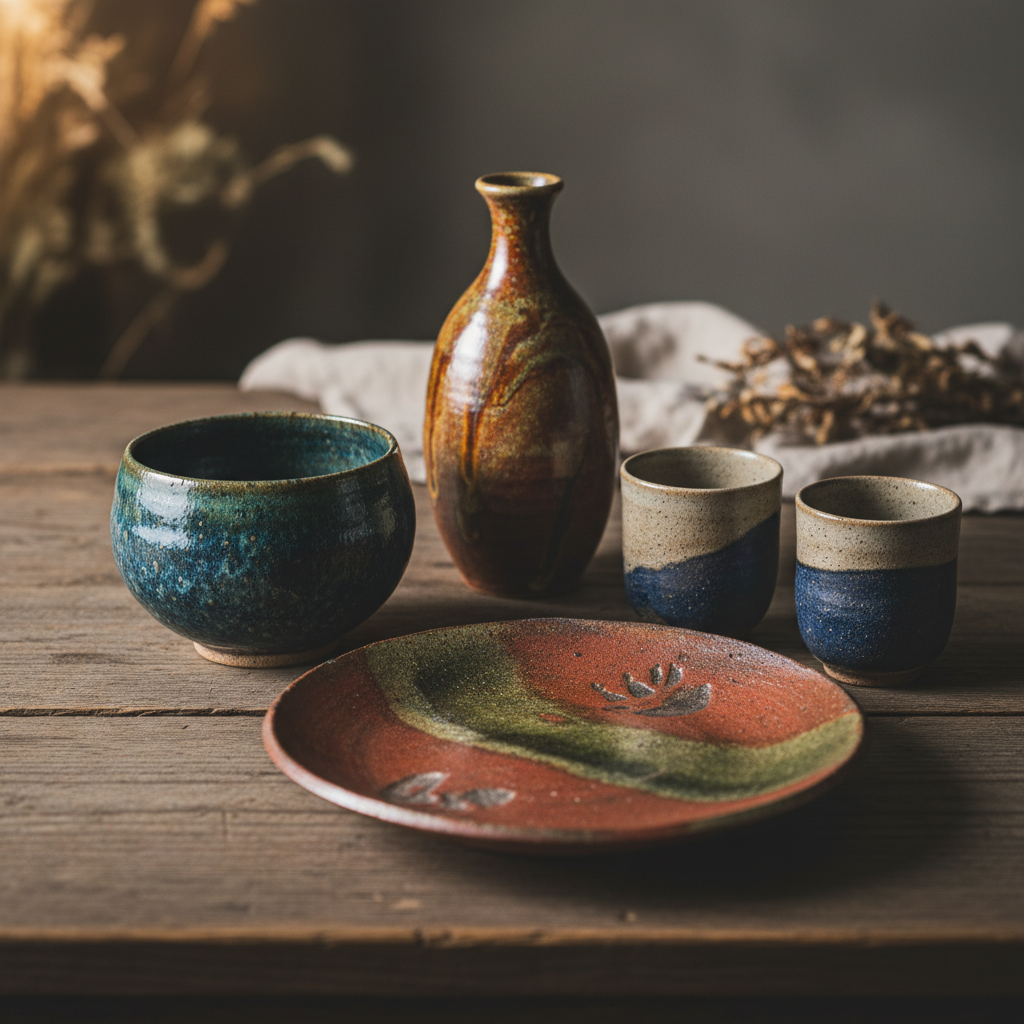
The distinctive blue-green color is what allows Matsushiro ware to be identified at a glance. This coloration results from natural glaze, expressed entirely from natural materials without chemical dyes.
This blue-green hue changes expression depending on light and viewing angle, possessing a beauty of depth. Though simple, it carries grace, and mysteriously harmonizes with both Japanese and Western spaces.
Simple Forms and Practicality
Another characteristic of Matsushiro ware is its simple forms. By avoiding excessive decoration and prioritizing vessel functionality, the design reflects an aesthetic sensibility akin to modern minimalism.
The shape that fits the hand, pleasant feel at the mouth, and ease of use are all based on the wisdom of craftsmen from 200 years ago. This high practicality is one reason Matsushiro ware remains beloved today.
Manufacturing Process of Matsushiro Ware | Inheritance of Traditional Techniques
Clay Preparation and Forming
Manufacturing Matsushiro ware begins with extracting local clay, removing impurities, and adjusting it to appropriate plasticity. The quality of the work is greatly affected at this clay preparation stage.
Forming is primarily done through hand-shaping using a potter’s wheel. Skilled craftsmen, having developed a sense through years of experience, create uniform thickness and beautiful forms. Especially large works such as jars and vessels require highly advanced technique.
Drying and Bisque Firing
After forming, works are allowed to dry naturally. Rapid drying causes cracking, so drying is conducted carefully while managing humidity and temperature.
After sufficient drying, bisque firing is conducted at around 800 degrees Celsius. At this stage, the clay gains the strength necessary to become ceramic.
Glaze Application and High Firing
Glaze is applied to bisque-fired works. The distinctive double-coating of Matsushiro ware, layering different glazes, produces the characteristic color and texture. This glaze application technique becomes a crucial process determining the final appearance of works.
High firing is conducted at over 1200 degrees Celsius. Various factors such as temperature distribution within the kiln, firing duration, and cooling rate all influence the final appearance of works. This process demonstrates craftsmen’s skill, requiring long years of experience and intuition.
Contemporary Matsushiro Ware Kilns | Artisans Preserving Tradition
Karakida Kiln | Pioneer of Matsushiro Ware’s Revival
The Karakida kiln was established by Karakida Matazō in 1964 (Showa 39) to revive Matsushiro ware. Currently operating a workshop in Shinonoi, Nagano City, second-generation successor Karakida Ishio carries on the traditional techniques.
The traditional glaze-blending technique that Matazō reproduced through research is carefully preserved today. Ishio inherits his father’s techniques while also challenging new creations suited to contemporary lifestyles, pursuing the coexistence of tradition and innovation.
In addition to traditional jars and bowls, Karakida kiln produces coffee cups and flower vessels, with many items accompanying modern living. The studio creates many works themed on Shinshū’s natural environment, expressing a unique world utilizing local materials and traditional techniques.
Matsushiro Pottery Studio (Matsui Kiln) | Conveying Tradition to Modern Times
Matsushiro Pottery Studio, operating as Matsui kiln, plays an important role in preserving Matsushiro ware’s tradition. With a workshop in Matsushiro Town, Nagano City, it continues creating works using traditional methods.
While cherishing Matsushiro ware’s original simple aesthetic, Matsushiro Pottery Studio primarily creates vessels suited for daily use. A variety of items adorning dining tables—teacups, tea bowls, plates, bowls—are available, popular with both locals and tourists.
The workshop also offers pottery experience programs, allowing visitors to actually experience the Matsushiro ware manufacturing process. Creating original works under craftsmen’s guidance offers memorable experiences perfect for preserving memories of Shinshū travels.
Other Artisans and Succession Challenges
While Matsushiro ware’s tradition is preserved centered on Karakida kiln and Matsushiro Pottery Studio, successor development remains an ongoing challenge. As with traditional crafts generally, technical inheritance by younger generations and adaptation to modern market needs are required.
Meanwhile, young ceramic artists interested in Shinshū’s traditional crafts have emerged, and movements of young potters studying Matsushiro ware techniques while pursuing new expression can be observed. Continuing innovation while preserving tradition will be key to unlocking Matsushiro ware’s future.
Types of Matsushiro Ware Works | Fusion of Tradition and Modernity
Traditional Daily-Use Items
The origin of Matsushiro ware lies in practical vessels for daily life.
- Jars and Vessels: Large traditional containers valued for storage
- Bowls: Multi-purpose vessels for serving and cooking
- Spouted Vessels: Convenient vessels with pouring spouts
- Sake Bottles and Cups: Standard items as sake ware
- Teacups and Tea Bowls: Indispensable vessels for daily dining
These traditional forms have been continuously produced for 200 years, representing works evoking Matsushiro ware’s history.
Works Adapted to Modern Living
Contemporary kilns, while utilizing traditional techniques, also produce works suited to modern lifestyles.
- Coffee Cups & Saucers: Japanese vessels accommodating Western beverages
- Mugs: Convenient sizes and forms for daily use
- Plate Collections: Various sized plates
- Flower Vessels and Vases: Beautiful works as interior décor
- Small Bowls and Mini Plates: Small items convenient for appetizers and side dishes
- Camping Tableware: Durable vessels usable outdoors
Particularly in recent years, influenced by camping booms, interest in ceramics usable outdoors has increased, with Matsushiro ware’s simple and durable characteristics being re-evaluated.
Matsushiro Ware as Artistic Works
Beyond practical items, works pursuing artistic expression are also created. Large works such as flower vessels and jars, and ceramic objects as objet d’art represent another facet of Matsushiro ware’s appeal.
These works maximize the beauty of traditional glazes, with many themed on Shinshū’s nature and seasons.
How to Purchase Matsushiro Ware | Acquisition Methods
Direct Purchase at Kilns
The most reliable purchasing method is visiting kilns directly.
At Karakida Kiln (Shinonoi, Nagano City) and Matsushiro Pottery Studio (Matsushiro Town, Nagano City), works can be purchased at galleries and sales spaces adjoining workshops. Examining works firsthand and hearing direct explanations from craftsmen offers significant advantages.
Contacting in advance before visiting is recommended. Timing permitting, workshop observation may be possible.
Retailers in Nagano City and Matsushiro
Within Matsushiro Town and Nagano City, souvenir shops and galleries handling Matsushiro ware exist. Around the Matsushiro Castle ruins tourist area, multiple stores carry Matsushiro ware.
Near Zenkoji Temple, souvenir shops sometimes stock Matsushiro ware as a Nagano Prefecture traditional craft.
Online Purchase
Some kilns and retailers operate online shops. Those in distant locations can purchase Matsushiro ware through the internet.
However, as each ceramic piece has a unique appearance, purchasing after viewing actual works is recommended if possible.
Events and Exhibitions
Opportunities to purchase Matsushiro ware arise at traditional craft exhibitions and pottery markets held throughout Nagano Prefecture and beyond. Craftspeople often sell directly, providing chances to learn details about works.
Matsushiro Ware Pottery Experience | Creating Your Own Work
Available Experience Content
Kilns such as Matsushiro Pottery Studio offer pottery experience programs. Beginner-friendly programs are available, including:
- Hand-shaping Experience: Creating vessels by hand-forming clay
- Potter’s Wheel Experience: Authentic forming using electric wheels
- Painting Experience: Decorating bisque-fired vessels with designs
Programs typically require 1-2 hours, with works fired later and sent by mail. Self-created Matsushiro ware becomes a particularly treasured travel memory.
Experience Reservation Methods
Pottery experience requires advance reservation. Each kiln’s website or telephone accepts reservations. Especially during tourist seasons and weekends, early reservation is recommended.
Prices vary by experience type, typically ranging from 2,000 to 5,000 yen.
Matsushiro Ware and Shinshū Tourism | Enjoying Complementary Attractions
Matsushiro Castle Ruins and Sanada Treasure Museum
Visiting Matsushiro ware kilns naturally invites enjoying Matsushiro’s historical tourism. The Matsushiro Castle ruins, seat of the Sanada clan, is popular as a beautifully maintained historic park.
The Sanada Treasure Museum displays items connected with the Sanada family, offering deep understanding of Matsushiro domain’s history and culture. Understanding the historical background when Matsushiro ware was born proves helpful.
Zenkoji Temple and Nagano City Sightseeing
Zenkoji Temple, Nagano City’s representative tourist destination, is approximately 30 minutes’ drive from Matsushiro. A route visiting this major Buddhist temple followed by Matsushiro ware kiln visits offers an ideal course for savoring Shinshū’s traditional culture.
Hot Springs and Nature
The Matsushiro area allows enjoying Shinshū’s abundant nature and hot springs. Chikuma River scenery, northern Shinano mountains, and local hot springs provide respite from travel fatigue.
Experiencing local cuisine on Matsushiro ware vessels and soaking in hot springs represents uniquely Shinshū experiences, embodying this region’s charm.
The Future of Matsushiro Ware | Inheritance and Development of Traditional Crafts
Efforts in Successor Development
Considering Matsushiro ware’s future, successor development is the paramount issue. Current kilns invest significantly in technical inheritance to the next generation through apprentice acceptance and pottery class offerings.
Nagano Prefecture also engages in protecting and nurturing traditional crafts, providing artisan development support and sales channel development assistance.
Addressing Contemporary Needs
While preserving tradition, creating works suited to contemporary lifestyles and preferences is necessary. Young-generation-appealing designs, improved functionality, and new use development require innovative approaches.
Re-evaluation as camping tableware and coffee cup development accommodating café culture represent contemporary demand-focused product development in progress.
Expansion to International Markets
Growing international interest in Japanese traditional crafts exists. Matsushiro ware’s simple beauty and practicality offer potential in international markets.
Enhanced sales to inbound tourists and participation in international exhibitions represent possible future global development perspectives.
Value as Regional Brand
Matsushiro ware constitutes an important element enhancing Matsushiro area and Nagano Prefecture brand value. Combined with Sanada clan heritage and tourism resources like Zenkoji, region-wide attractiveness can be enhanced.
Culinary experiences combining local ingredients with Matsushiro ware vessels, tours combining pottery experience with historical sightseeing represent expected multi-faceted tourism product development.
Conclusion | Matsushiro Ware: Shinshū’s Treasured Traditional Ceramics
Matsushiro ware, with over 200 years of history produced in Matsushiro Town, Nagano City, Nagano Prefecture, is a traditional ceramic. Born in the Sanada clan’s castle town and developing under domain encouragement, this pottery, utilizing locally iron-rich clay and naturally-sourced glazes, is characterized by its distinctive blue-green color and simple aesthetic.
Though once in decline, Matsushiro ware was revived in 1964 (Showa 39) by Karakida Matazō, with tradition currently preserved centering on Karakida kiln and Matsushiro Pottery Studio. Ranging from practical daily-use items to artistic works, the broad spectrum of productions possess charm integrating with contemporary living.
When visiting Shinshū, be sure to visit Matsushiro ware kilns, experiencing 200 years of living tradition through the vessels. Pottery experience, creating with your own hands, becomes an unforgettable memory. Matsushiro ware, where local materials and craftspeople’s technique converge, truly represents Nagano Prefecture’s traditional craft, condensing Shinshū’s culture and nature.

