Izushi Ware (いずしやき) Complete Guide|Traditional White Porcelain Craft Representing Hyogo Prefecture: Characteristics, History, and Production Area Information
What is Izushi Ware? White Porcelain Ceramics Representing Hyogo Prefecture
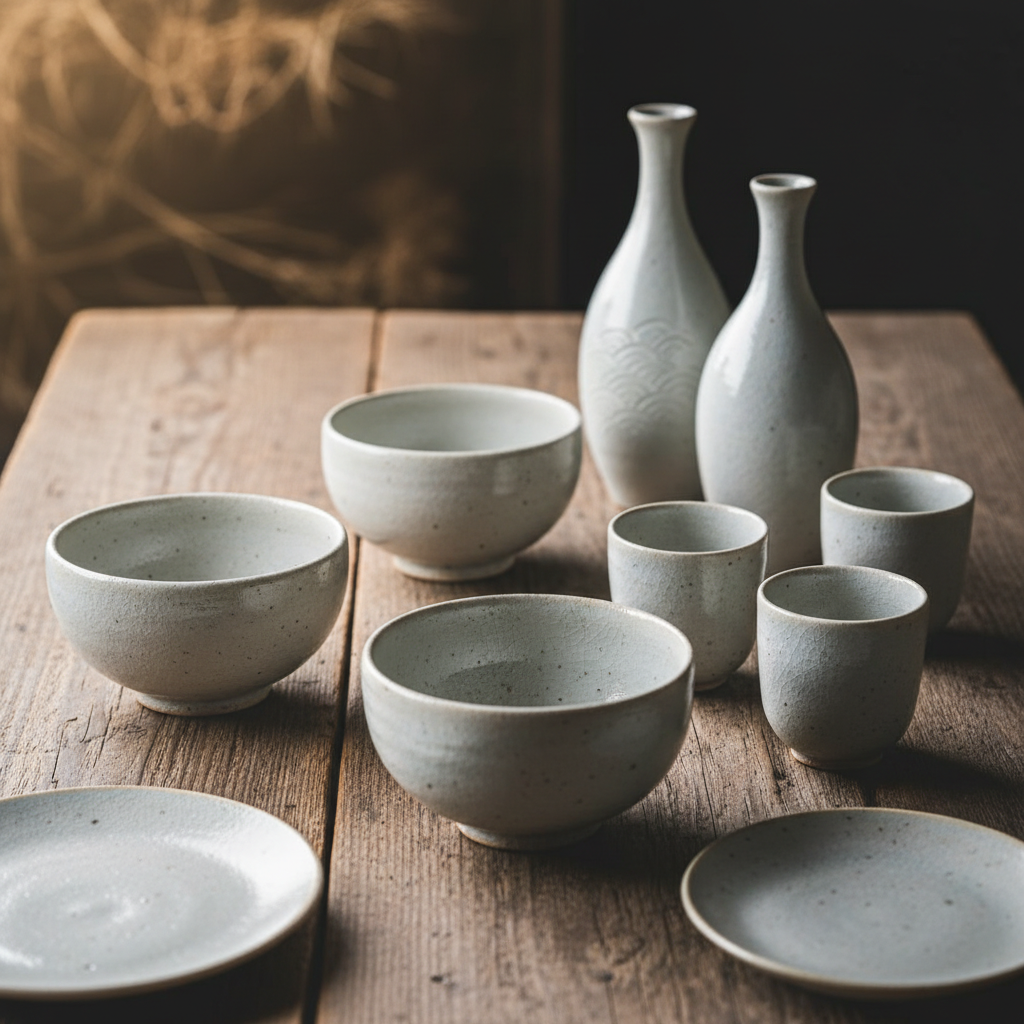
Izushi ware (いずしやき) is porcelain produced in the Izushi area of Toyooka City, Hyogo Prefecture, and is also called “Izushi white porcelain (いずしはくじ).” It is known as a rare type of pottery in Japan centering on white porcelain, and its greatest characteristics are the transparent, pure white porcelain surface and the exquisite patterns created through relief carving and openwork.
In March of Showa 55 (1980), it was designated as a traditional craft by the Minister of International Trade and Industry (now the Minister of Economy, Trade and Industry). Izushi town is a historic area that flourished as a castle town during the Edo period, and even today, four kiln studios continue to manufacture Izushi ware while inheriting traditional techniques.
The whiteness of Izushi ware is called “mysteriously white,” possessing a unique beauty that sets it apart from porcelain from other production areas. The pure white material called “Kakigaya ceramic stone” mined locally is what produces this ultimate whiteness.
The Greatest Characteristics of Izushi Ware|Translucent Whiteness and Delicate Craftsmanship
Pure White Beauty Brought by Kakigaya Ceramic Stone
The greatest characteristic of Izushi ware is undoubtedly its whiteness. The ceramic stone that produces this whiteness is “Kakigaya ceramic stone,” a high-quality ceramic stone mined in Izushi town. Because Kakigaya ceramic stone contains extremely low amounts of iron, when fired, it produces a translucent, pure white porcelain surface.
This whiteness is expressed as “snowy white” or “silken white,” and possesses a unique character different from other porcelain production areas in Japan such as Arita ware and Kutani ware. When light is applied to it, one can feel a mysterious beauty as if light were transparently visible from within.
Delicate Relief Carving and Openwork Techniques
Another characteristic of Izushi ware is the delicate sculptural technique by skilled potters. The techniques primarily used are “relief carving” and “openwork (transparent carving),” which apply three-dimensional patterns to the pure white porcelain surface.
Relief carving is a technique in which the surface of the material is carved out to make patterns stand out, expressing flowers, birds, landscapes, and geometric patterns. Openwork is a technique in which holes are made in the material to create patterns, and when light passes through, beautiful shadows are created. These techniques are performed when the material is still slightly damp, so a high level of skill and experience is required.
Silken Smooth Texture
The surface of Izushi ware possesses a smooth texture like silk. This is realized by the fine and uniform particles of Kakigaya ceramic stone and by properly managing the firing temperature. When held in hand, one is struck by its smoothness and lightness.
This texture demonstrates excellent properties as a vessel for everyday use. It has a pleasant mouthfeel and does not interfere with the taste of beverages or dishes, earning high praise as a tea implement and tableware.
History of Izushi Ware|Ceramic Tradition Continuing from Ancient Times to the Present
Ancient Legend|The Legend of Amenohiboko
The origin of Izushi ware traces back to ancient times through legend. According to the “Nihon Shoki,” during the reign of Emperor Suinin, Amenohiboko brought potters from the Korean peninsula to Izushi in Tajima Province, and began firing vessels necessary for food, clothing, and housing.
Whether this legend is historical fact is uncertain, but it is a fascinating legend showing that the Izushi region has long been connected with ceramic production. In Izushi, there is the Izushi Shrine, which enshrines Amenohiboko, and is deeply intertwined with the region’s history.
Mid-Edo Period|The Practical Beginning of Izushi Ware
The direct origin of current Izushi ware dates to Tenmeii 4 (1784) in the mid-Edo period. In this year, a merchant from Izushi named Izuya Yasaemon opened an earthenware kiln in Hosomi Village, Izushi County (currently the Sakurawo district).
According to Izuya Yasaemon’s diary, he hired a craftsman named Kyuhachi from Tanba, a renowned pottery production area, and with the support of the Izushi domain, constructed a kiln. Initially, the production of earthenware (earth-fired pottery) began, with production centered on everyday tableware.
Transition to Porcelain|Discovery of Kakigaya Ceramic Stone
Izushi ware became a white porcelain production area as it is today when high-quality porcelain material was discovered locally. Around Bunka 1 (1804), Sengoku Sakyo, the elder of the Izushi domain, discovered white ceramic stone in Kakigaya, Izushi town. This later became known as “Kakigaya ceramic stone,” the very lifeblood of Izushi ware’s material.
Following this discovery, the Izushi domain began focusing efforts on porcelain production. To learn the techniques of Arita ware, potters were invited from Hizen (present-day Saga Prefecture), and porcelain manufacturing techniques were introduced. In Bunka 4 (1807), Izumiya Jihei began full-scale porcelain production, and Izushi ware was established as a white porcelain production area.
Protection and Development by the Izushi Domain
Izushi ware was protected and cultivated as the domain kiln of the Izushi domain. The domain invited skilled potters, worked to improve techniques, and also put effort into product quality control. In particular, the development of delicate carving techniques was greatly aided by domain support.
From the late Edo period through the Meiji period, Izushi ware came to receive high evaluation in the upper markets of Kyoto and Osaka as tea implements and high-quality tableware. In particular, decorative pieces such as incense burners and flower vases with openwork were highly prized for their high artistic value.
Changes in the Meiji, Taisho, and Showa Periods
After the Meiji Restoration, Izushi ware lost the protection of the domain due to the abolition of the feudal system and faced a crisis of decline. However, private kiln studios inherited the techniques and made efforts to develop new markets. During the Meiji period, new products with Western techniques incorporated were also created.
From the Taisho period through the early Showa period, the production of everyday tableware became the center, becoming established as a local industry. During World War II, production became difficult due to shortages of materials and fuel, but after the war, recovery was achieved, and efforts were made to balance the inheritance of traditional techniques with the creation of new works.
Designation as a Traditional Craft and the Modern Era
In March of Showa 55 (1980), Izushi ware was designated as a traditional craft by the national government. Through this designation, the traditional techniques and cultural value of Izushi ware were officially recognized, and a system for protection and inheritance was established.
Currently, four kiln studios, including Nagasawa Brothers Ceramic Studio, continue to manufacture Izushi ware while preserving traditional techniques. In addition to traditional tea implements and tableware, new designs adapted to modern lifestyles are also being developed, and the craft continues to evolve as a familiar art form for younger generations.
Manufacturing Process of Izushi Ware|Traditional Techniques Creating the Beauty of White Porcelain
Mining and Refining of Raw Materials
The manufacturing of Izushi ware begins with the mining of Kakigaya ceramic stone. Ceramic stone mined in the Kakigaya district of Izushi town is first crushed finely in a crusher. After that, in a process called water separation (suihi), impurities are removed to create high-purity ceramic clay.
In water separation, crushed ceramic stone is mixed with water and stirred, and impurities are settled using differences in particle size and weight. Collecting the fine particles in the supernatant and drying them completes the pure white and smooth ceramic clay unique to Izushi ware. This process is an important task that determines the whiteness of Izushi ware.
Forming|Shaping Through the Wheel and Molds
The refined ceramic clay is shaped into vessel forms through wheel forming or mold forming. Round vessels such as bowls and tea cups are made using a wheel, while vessels with complex shapes are made using plaster mold forming.
In wheel forming, the ceramic clay is shaped by hand on a rotating platform. Skilled potters create vessels of uniform thickness using only their sense of touch. Izushi ware often features thin-walled vessels, requiring a high level of technique.
In mold forming, ceramic clay is pressed against plaster molds to create the shape. For vessels with complex relief patterns, molds with patterns already carved may be used.
Carving|Relief Carving and Openwork Techniques
When the formed vessel reaches a semi-dry state (leather-hard), the carving process begins. This is the most characteristic process of Izushi ware, where the skill of experienced craftsmen shines.
Relief carving uses a specialized carving knife to carve the surface of the vessel, making patterns stand out. Flowers, birds, geometric patterns, and other motifs are expressed delicately. By carefully adjusting the depth and angle of carving, three-dimensional beautiful patterns are created.
Openwork is a more advanced technique that requires creating patterns by drilling holes in the vessel. Drilling fine holes in thin-walled vessels requires precise control, as even slight mistakes in pressure can crack the vessel. The completed openwork vessel creates beautiful shadows when light passes through it, raising its value as an art piece.
Drying and Bisque Firing
After carving is completed, the vessel is completely dried. Drying too rapidly causes deformation or cracks, so the drying is done slowly over time.
After drying, bisque firing is performed at approximately 800–900 degrees Celsius. Bisque firing strengthens the vessel and makes the next process of glazing easier.
Glazing and Final Firing
Glaze is applied to the bisque-fired vessel. Izushi ware primarily uses transparent glaze or white glaze. The glaze is applied evenly across the entire vessel using methods such as dipping or spray glazing.
After glazing, final firing is performed at approximately 1,250–1,300 degrees Celsius. This high-temperature firing causes the Kakigaya ceramic stone to completely vitrify, producing the translucent whiteness and hardness. Firing takes approximately 12–15 hours, after which the vessel cools slowly.
Temperature control in the kiln is extremely important; if the temperature is too low, sufficient whiteness does not develop, and if too high, the vessel may deform or the glaze may flow. Temperature management based on long years of experience determines the quality of Izushi ware.
Painted Decoration and Overglaze Firing
After final firing, painted decoration is applied when necessary. In Izushi ware, decoration is often applied sparingly to highlight the beauty of the white porcelain, though vibrant works with gold or colored painting also exist.
Decoration can be applied either “underglaze” below the glaze or “overglaze” above the glaze. For overglaze decoration, overglaze firing at approximately 800 degrees is performed after painting to fix the pigment.
Inspection and Finishing
Once firing is complete, each vessel is carefully inspected individually. Cracks, deformation, glaze unevenness, and other defects are checked, and only products meeting standards are shipped.
Finally, the bottom of the vessel is polished to a smooth finish, and the product is complete. Through this series of processes, Izushi ware with its unique whiteness and beauty is born.
Production Area Information about Izushi Ware|Izushi Town, Toyooka City, Hyogo Prefecture
History and Culture of Izushi Town
Izushi town, the production area of Izushi ware, is located in the Tajima region in northern Hyogo Prefecture as part of Toyooka City. During the Edo period, it flourished as the castle town of the Izushi domain with 58,000 koku, and is also called the “Kyoto of Tajima” with its picturesque townscape remaining.
Having developed as the castle town of Izushi Castle, Izushi town retains historical scenery with the grid-patterned town layout, white-walled storehouses, and samurai residences still remaining. Izushi ware was nurtured within this castle town culture, developing while receiving domain protection.
Izushi Soba and Tourism
Izushi town is also famous for “Izushi soba” alongside Izushi ware. Izushi soba is also called “dish soba,” characterized by soba served in small plates, with the style of eating many plates. There are approximately fifty soba restaurants throughout town, attracting many tourists.
Some restaurants serve Izushi soba in Izushi ware vessels, making it a popular tourist destination where both traditional crafts and local cuisine can be enjoyed. Eating soba in the beautiful white porcelain vessels is exceptional both visually and in taste.
Current Kiln Studios and Workshops
Currently, there are primarily four kiln studios manufacturing Izushi ware in Izushi town. Among the representative studios is Nagasawa Brothers Ceramic Studio. Each studio continues to preserve traditional techniques while also creating new designs adapted to modern living.
Many studios accept workshop tours and pottery experience activities, allowing tourists to observe the actual manufacturing process of Izushi ware, enjoy experiences such as wheel-throwing or painted decoration, and gain a deeper understanding of the value and charm of Izushi ware by witnessing the craftsmen’s skills firsthand.
Access Information
Access to Izushi town is approximately 30 minutes by Zen-Tan Bus from Toyooka Station on the JR Sanin Main Line. By car, it is approximately 20 minutes from the Yoka Hyonokage IC on the Kitago-Toyooka Expressway, or approximately 25 minutes from the Hidaka-Kammage Kogen IC.
Multiple free parking lots are available within town, making access by car convenient. The castle town’s townscape is compact enough to explore on foot, and one can walk to tour the studios and shops of Izushi ware, Izushi Castle ruins, soba restaurants, and more.
Places to Purchase Izushi Ware
Izushi ware can be purchased at the direct studios and shops of each kiln studio in Izushi town, as well as at the Izushi Tourism Center. The studios carry a wide range of products from everyday-use vessels such as bowls and tea cups to decorative pieces such as flower vases and incense burners.
Price ranges vary from several thousand yen for small tea cups to several tens of thousands of yen or more for large flower vases and highly artistic works. Since each piece is handmade by craftsmen, even identical designs have subtle variations in character, offering the pleasure of selecting one’s own unique piece.
Izushi ware can also be purchased through internet mail order, making it possible to obtain items from distant locations. However, purchasing at the production site where one can hold the actual piece and confirm its texture and weight is recommended.
How to Use and Care for Izushi Ware
As Everyday Tableware
Izushi ware, though appearing to be for viewing due to its beauty, also possesses excellent characteristics as everyday tableware. As porcelain, it has no water absorption, and stains and odors do not easily attach.
Bowls, tea cups, plates, and other items can be used freely in daily meals. White porcelain vessels beautifully complement any dish. In particular, they have the effect of highlighting the subtle colors and presentations of Japanese cuisine.
Care Methods
Care for Izushi ware is relatively simple. After use, wash with a neutral detergent using a soft sponge. Since porcelain is highly durable, it resists scratches, but avoid using metal scrubbers or abrasive cleansers.
Regarding use in dishwashers or microwave ovens, this varies by product. Vessels with gold or silver decoration should not be used in microwaves or dishwashers. Basic plain white porcelain vessels can generally be used, but it is recommended to confirm at the time of purchase.
Storage Methods
When storing Izushi ware, if stacking pieces, placing soft cloth or kitchen paper between vessels prevents scratches and chips. In particular, vessels with delicate decoration such as openwork should ideally be stored separately.
If not using for extended periods, dry thoroughly before storing. Avoid damp locations and store in a well-ventilated place.
Other Ceramic Production Areas in Hyogo Prefecture
Tanba Ware (Tachikui Ware)
Besides Izushi ware, Hyogo Prefecture has other traditional ceramic production areas. The most famous is “Tanba ware (Tachikui ware)” produced in Tanba Sasayama City. Tanba ware is counted among Japan’s Six Ancient Kilns and has a long history dating back to the late Heian period.
In contrast to the white porcelain of Izushi ware, Tanba ware is pottery that brings out the warmth of clay. Its characteristics are reddish-brown or gray simple colors and unique landscapes created by natural glaze. Beginning with everyday items such as jars and mortars, tea ceramics and flower vessels are now also created.
Ojiyama Ware
“Ojiyama ware” fired on Ojiyama in Nada Ward, Kobe, also occupies an important position in the history of ceramics in Hyogo Prefecture. It was produced from the late Edo period through the Meiji period, but is currently discontinued.
Ojiyama ware was colored porcelain influenced by Kyoto ware, characterized by vibrant painted decoration. Recently, efforts to revive it have begun, and attempts are being made to convey traditional techniques to the modern era.
Modern Development and Future of Izushi Ware
Fusion of Tradition and Innovation
Current Izushi ware preserves traditional techniques while working on new product development adapted to modern lifestyles and design sensibilities. Vessels with innovative designs by young artists and objects suited to modern interiors are also emerging.
Products that activate traditional relief and openwork techniques while modernizing shapes, sizes, and uses are attracting attention from younger generations. For example, products such as coffee cups, wine glasses, and accessories are appearing, going beyond the traditional framework of Japanese tableware.
Successor Training and Technical Inheritance
Like many traditional crafts, Izushi ware faces the challenge of insufficient successors. The aging of experienced craftsmen and the training of young workers is an issue.
In response to this challenge, each studio actively accepts apprentices and runs pottery classes to work on technical inheritance. Additionally, efforts to have students learn about Izushi ware within school education and region-wide efforts to preserve tradition are underway.
Utilization as a Tourism Resource
Izushi town continues to develop as a tourist destination centered on Izushi ware and Izushi soba. Workshop tours and pottery experiences provide valuable opportunities to directly communicate the charm of Izushi ware to tourists, leading to fan acquisition.
Tourists who touch Izushi ware through experience often actually purchase products and become repeat visitors, contributing to the activation of the production area. Active information dissemination through social media is also raising awareness among younger generations.
Possibilities for International Expansion
Interest in Japanese traditional crafts among overseas audiences is increasing year by year, and Izushi ware is exploring expansion into international markets. The beauty of white porcelain and delicate techniques hold potential for high evaluation overseas.
Efforts such as exhibiting at international craft fairs and strengthening responses to inbound tourists are beginning. English-language information dissemination and design development for overseas markets are also progressing, broadening new possibilities for Izushi ware.
Conclusion|Passing the Charm of Izushi Ware to the Next Generation
Izushi ware is a traditional craft that Toyooka City’s Izushi town in Hyogo Prefecture takes pride in, and its greatest charm lies in its translucent, pure white beauty and delicate carving techniques. Produced through high-quality local material called Kakigaya ceramic stone and skilled craftsmanship continuing from the Edo period, Izushi ware occupies a unique position in Japanese ceramic culture.
With a history of over 240 years from its founding in Tenmeii 4 (1784), Izushi ware developed under the protection of the Izushi domain and was designated as a traditional craft by the national government in Showa 55 (1980). Currently, four kiln studios continue to preserve tradition while also working on new product development suited to the times.
Visiting Izushi town allows one to enjoy workshop tours and pottery experiences of Izushi ware within the picturesque castle town scenery. It is also a valuable tourist destination where one can experience the culture of the Tajima region along with Izushi soba.
Whether as everyday tableware or as art objects, Izushi ware brings richness and beauty to our lives. By holding and experiencing the beauty of white porcelain and contemplating its history and techniques, one can reaffirm the excellence of Japanese traditional crafts.
Passing the tradition of Izushi ware to the next generation is not merely preserving techniques but also transmitting Japanese aesthetic sensibilities and culture to the future. Each of us, by taking interest in Izushi ware, using it, and understanding its value, becomes a force supporting traditional crafts.
Should you have the opportunity to visit Hyogo Prefecture, please make sure to visit Izushi town and directly experience the charm of Izushi ware, which boasts the ultimate in whiteness.