
Aizu Hongō Yaki Complete Guide|History and Charm of Fukushima Prefecture’s Celebrated Ceramic Production Center
Aizu Hongō yaki (会津本郷焼), rooted in Fukushima Prefecture’s Aizu region, is the oldest ceramic production center in the Tōhoku region with a history of approximately 400 years. Centered in Aizu Misato Town (formerly Aizu Hongō Town), more than 15 kilns continue to preserve traditional techniques today while creating vessels that harmonize with contemporary daily life.
As the only production center north of the Kantō region to produce both pottery and porcelain, Aizu Hongō yaki occupies a special position in Japan’s ceramic culture. This article provides a detailed explanation of the complete picture of this traditional craft, covering the history, characteristics, manufacturing techniques, and contemporary appeal of Aizu Hongō yaki.
Aizu Hongō Yaki Explained|Fukushima Prefecture’s Representative Ceramic Production Center
Aizu Hongō yaki is a collective term for pottery and porcelain produced in the area surrounding Hongō district in Aizu Misato Town (formerly Aizu Hongō Town), Ōnuma County, Fukushima Prefecture. Named after the locality, it is also called “Aizu yaki” or “Hongō yaki,” and includes kilns located in Aizu Wakamatsu City.
Definition and Production Area of Aizu Hongō Yaki
The production area of Aizu Hongō yaki is centered mainly on the Hongō district of Aizu Misato Town, Fukushima Prefecture, though some kilns in the adjacent Aizu Wakamatsu City are also included. This region has long been blessed with high-quality ceramic clay and stone, providing an environment well-suited for ceramic production.
The characteristic feature as a production center is that both pottery (tsuchimono) and porcelain (ishimono) are manufactured. While many ceramic production centers specialize in either pottery or porcelain, Aizu Hongō yaki has inherited both techniques. This is a unique characteristic north of the Kantō region and represents a major appeal of Aizu Hongō yaki.
The Rarity of Producing Both Pottery and Porcelain
Aizu Hongō yaki encompasses pottery (tsuchimono) deriving from tile-making traditions and porcelain (ishimono) using Ōkubo ceramic stone as raw material. Pottery, with soil as its primary ingredient, possesses a warm texture and water-absorbing properties. Conversely, porcelain, made from stone, is hard, has translucency, and is characterized by its beautiful whiteness.
The coexistence of these two distinct techniques within a single production center is a rare phenomenon nationwide. This enables Aizu Hongō yaki to offer diverse expressions, producing works ranging from traditional styles to contemporary designs.
History of Aizu Hongō Yaki|Tracing 400 Years of Tradition
The history of Aizu Hongō yaki dates back to the late Sengoku and early Edo periods and has been transmitted across approximately 400 years. This history can be divided into three major periods.
Origins|Introduction of Tile-Making by Gamō Ujisato (1593)
The origins of Aizu Hongō yaki trace back to 1593 (Tenshō 21/Bunroku 2). Gamō Ujisato (1556–1595), the feudal lord of Aizu at the time, invited tile workers from Harima Province (present-day Hyogo Prefecture) to manufacture roof tiles for Kurokawa Castle (Wakamatsu Castle, Tsuruga Castle).
Gamō Ujisato was a Sengoku warlord who served both Oda Nobunaga and Toyotomi Hideyoshi and dedicated himself to organizing the castle town of Aizu Wakamatsu. He possessed considerable cultural refinement and deep knowledge of tea ceremony, establishing the foundation for ceramic culture to take root in the Aizu region.
Initially, production focused on tiles and miscellaneous daily wares, but the techniques cultivated during this period became the foundation for the later development of Aizu Hongō yaki.
Establishment of Pottery|Achievements of Mizuno Genzaemon (1647)
The formal beginning of pottery production in Aizu Hongō yaki dates to 1647 (Shōho 4), when Mizuno Genzaemon (水野源左衛門) invited ceramic artisans from Arita in Hizen (present-day Saga Prefecture) at the command of Aizu domain lord Hoshina Masatsune to begin pottery manufacture.
Hoshina Masatsune was a grandson of Tokugawa Ieyasu and served as the first lord of the Aizu Matsudaira clan, dedicating himself to industrial promotion in Aizu. Mizuno Genzaemon produced pottery as a domain kiln and is enshrined in the Pottery Founders’ Shrine (Tōso byō) as the ancestor of Aizu Hongō yaki pottery.
The pottery production techniques established during this period underwent unique development suited to Aizu’s climate and topography, with a wide range of products created, from everyday tableware to tea ceramics.
Birth of Porcelain|Discovery of Ceramic Stone by Satō Ihei (1800)
A watershed moment in Aizu Hongō yaki history arrived in 1800 (Kansei 12). Satō Ihei (佐藤伊兵衛) discovered high-quality ceramic stone in Ōkubo in Hongō and succeeded in manufacturing porcelain.
Satō Ihei is enshrined alongside Mizuno Genzaemon in the Pottery Founders’ Shrine as the ancestor of Aizu Hongō yaki porcelain. The Ōkubo ceramic stone he discovered is high-quality raw material suitable for producing white porcelain, enabling Aizu Hongō yaki to develop into a production center capable of manufacturing both pottery and porcelain.
As a ceramic production center using stone as raw material, Aizu Hongō yaki became the sole such production center north of the Kantō region, with this rarity continuing to be a defining characteristic of Aizu Hongō yaki to this day.
Prosperity During the Domain Period and Development as a Domain Kiln
Throughout the Edo period, Aizu Hongō yaki flourished as a kiln for the Aizu Matsudaira domain. Under domain protection, technical improvement and expansion of production scale progressed, making Aizu Hongō yaki one of the domain’s important industries.
Particularly during the late Edo period, as the Aizu domain served as Kyoto Shugoshoku (Protector of Kyoto), Aizu Hongō yaki was valued as a craft symbolizing domain prestige. The high technical standards cultivated during this period were transmitted beyond the Meiji Restoration.
Changes in Modern Times and Transmission to the Present
After the Meiji Restoration, Aizu Hongō yaki, having lost domain protection through the abolishment of the han system, temporarily faced hardship. However, kiln operators engaged in product development to meet civilian demand, maintaining the production center through the manufacture of daily household wares and art crafts.
During the Shōwa period, the value of Aizu Hongō yaki as a traditional craft was recognized anew, and in 1993, it was designated as a Fukushima Prefecture traditional craft. Currently, an increasing number of kiln operators work to preserve traditional techniques while creating vessels suited to contemporary lifestyles.
Characteristics of Aizu Hongō Yaki|Diversity of Techniques and Materials
The greatest characteristic of Aizu Hongō yaki is producing both pottery and porcelain, though numerous other appealing features exist.
Characteristics and Appeal of Tsuchimono (Pottery)
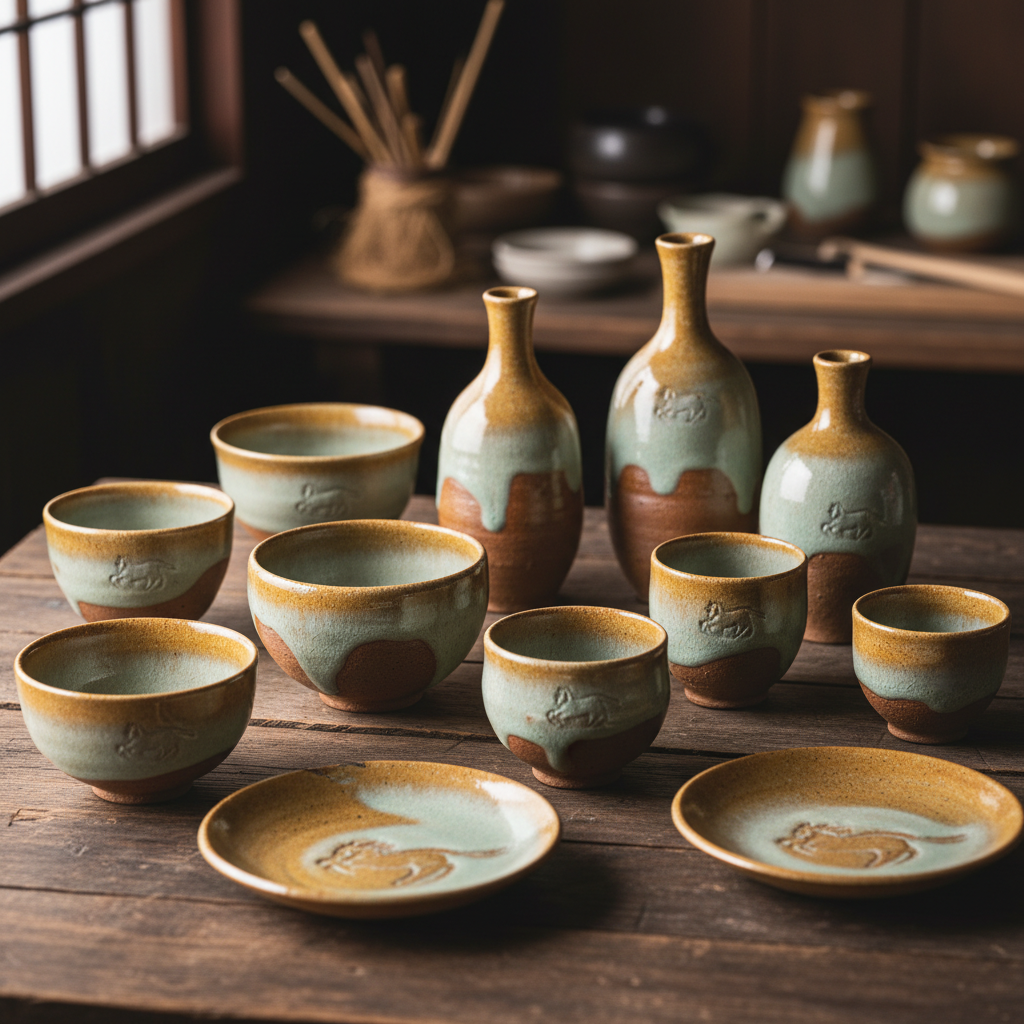
Aizu Hongō yaki pottery uses ceramic clay sourced locally as its primary material. Deriving from tile-making traditions, works are characterized by their simple, warm quality that showcases the clay’s natural appearance.
The pottery surface is porous and water-absorbing, possessing the appeal of a “vessel to cultivate” where beauty increases with use. The variety of glazes is abundant, enabling enjoyment of diverse expressions through amber glaze, iron glaze, ash glaze, and more.
Tsuchimono Aizu Hongō yaki encompasses a wide range of products, from everyday wares like rice bowls, tea cups, plates, and bowls to flower vessels and tea ceremony implements. Particularly, the simple, rustic aesthetic that showcases clay texture is highly regarded as Japanese tableware.
Characteristics and Appeal of Ishimono (Porcelain)
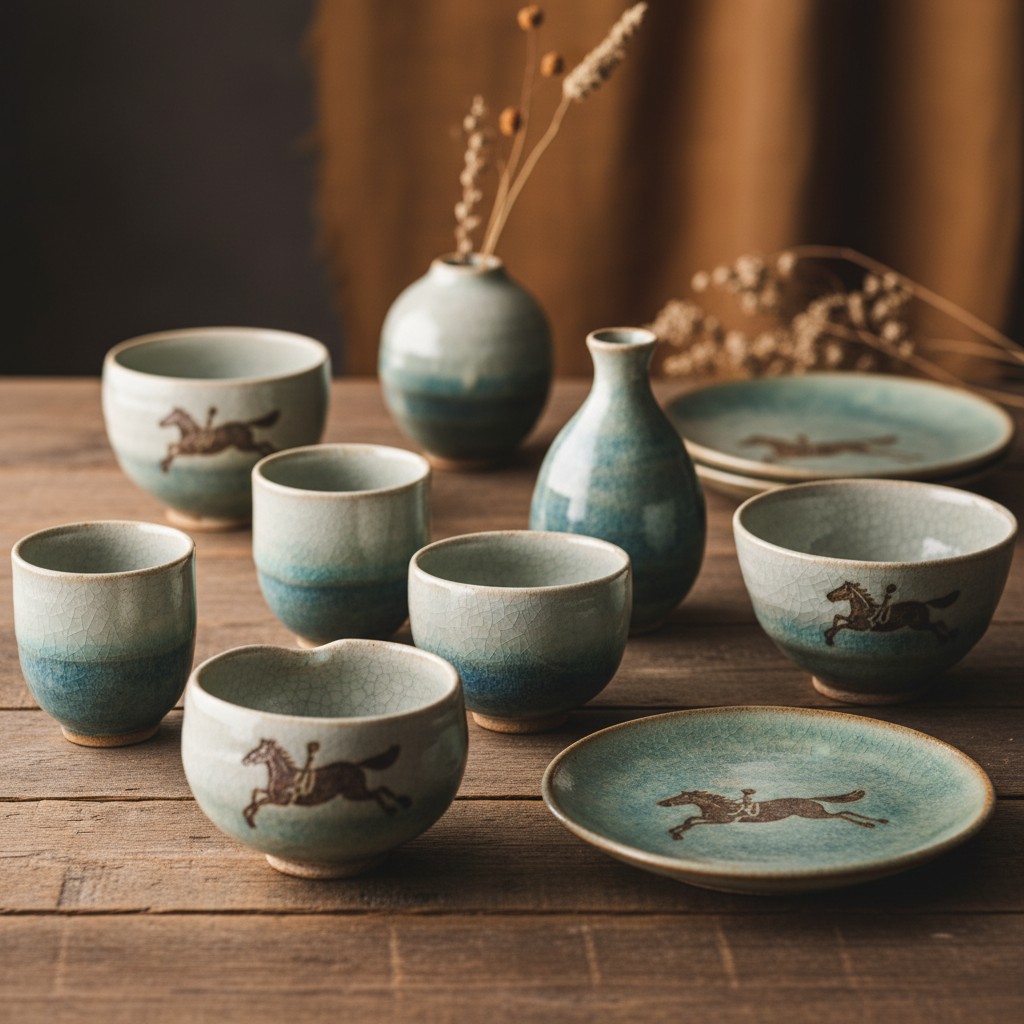
Aizu Hongō yaki porcelain uses Ōkubo ceramic stone as its raw material. This stone is high-quality, allowing the creation of beautiful white porcelain. Because porcelain is fired at high temperatures, it is hard, non-absorbent, and possesses excellent durability.
The porcelain surface is smooth and glossy, and because it maintains strength even when thinly formed, delicate shaping is possible. Another characteristic of porcelain is the ability to accentuate the beauty of painting, whether through underglaze blue (sometsuke) or overglaze enamel decoration.
Aizu Hongō yaki porcelain displays varied expressions, ranging from simple designs showcasing the beauty of white porcelain to vibrant works featuring traditional patterns.
Diversity of Glazes and Decorative Techniques
Aizu Hongō yaki employs diverse glazes and decorative techniques. In pottery, glazes such as amber glaze, iron glaze, Oribe glaze, and Yellow Seto glaze—which enhance the clay’s natural appearance—are used. In porcelain, transparent glaze, celadon glaze, and white porcelain glaze are common.
Decorative techniques are equally abundant, including underglaze blue painting (sometsuke using cobalt oxide), overglaze enamels, scraffito, inlay, and edge-trimming, with various techniques being transmitted. Combining these techniques produces richly individual works.
Fusion of Contemporary Design and Tradition
In recent Aizu Hongō yaki production, vessels with contemporary lifestyles in mind have become increasingly common while maintaining traditional techniques as their foundation. Simple, modern forms, Nordic-inspired color schemes, and pastel colors popular with younger generations reflect product development responsive to contemporary needs.
Conversely, kiln operators faithfully preserving traditional styles continue to exist, resulting in a production center with diverse product composition overall. This wide range of options represents another appeal of Aizu Hongō yaki.
Manufacturing Process of Aizu Hongō Yaki|Craftsmen’s Skills and Handwork
The manufacturing process of Aizu Hongō yaki differs somewhat between pottery and porcelain but follows a fundamentally shared sequence. Here, the traditional handcraft manufacturing process is introduced.
Raw Material Extraction and Refinement
In pottery production, local ceramic clay is extracted; in porcelain production, Ōkubo ceramic stone is extracted. Ceramic clay undergoes water separation (suihi) to remove impurities and is adjusted for appropriate plasticity. Ceramic stone is pulverized, mixed with water to create a slurry, and then refined to remove impurities.
Refined raw material is adjusted to appropriate moisture content and thoroughly worked to achieve a state suitable for shaping. The clay-working process is critical for removing air from the soil and creating uniform clay.
Shaping Techniques
Aizu Hongō yaki shaping primarily employs wheel-throwing, hand-building, and mold-forming.
Wheel-throwing involves placing clay on a rotating disk and utilizing centrifugal force to create circular vessels. Skilled craftspeople produce beautifully uniform vessels of consistent thickness with minimal adjustments.
Hand-building shapes clay by hand, enabling creation of freely formed vessels. It is used for one-of-a-kind art pieces and vessels with distinctive designs.
Mold-forming uses plaster molds and similar to create multiple vessels of identical shape, proving well-suited for mass production.
Drying and Bisque Firing
Shaped vessels are slowly dried naturally. Rapid drying causes cracking, necessitating careful drying under controlled temperature and humidity.
After thorough drying, bisque firing occurs at approximately 800 degrees Celsius. Bisque firing hardens the vessel and creates a state favorable for glaze application.
Glazing and Decoration
Glaze is applied to bisque-fired vessels. Various techniques—including dipping, pouring, and spraying—are employed depending on artistic intention.
Underglaze decoration such as blue-and-white painting occurs after bisque firing and before glazing. Images and patterns are drawn using cobalt oxide (gosezu), then transparent glaze is applied. Overglaze decoration such as enameling occurs after the final firing.
Final Firing and Completion
Glazed vessels are placed in kilns and fired at high temperatures between 1200 and 1300 degrees Celsius. Pottery is generally fired at approximately 1200 degrees, porcelain at approximately 1300 degrees.
Firing duration varies with kiln type and vessel size, but typically involves gradually raising temperature over 10 to 24 hours, maintaining the highest temperature, then gradually cooling. Vessels removed from the kiln are inspected, and finishing work such as polishing is performed as necessary before completion.
Kilns and Artists of Aizu Hongō Yaki|Diverse Creators
The production center currently hosts more than 15 kilns, each producing work with distinctive individuality. From kilns preserving traditional styles to those embracing contemporary design, the field possesses considerable diversity.
Characteristics of Representative Kilns
Each Aizu Hongō yaki kiln possesses long history and unique techniques. Some longstanding kilns have continued since the Edo period, preserving inherited techniques and aesthetic sensibilities across generations.
Simultaneously, young artists with contemporary sensibilities have opened studios and produce modern-design vessels. Works incorporating contemporary elements—such as color schemes and forms—while maintaining traditional techniques as their foundation increasingly attract younger generation support.
Diverse Artistic Activity
Beyond kiln-affiliated artisans, numerous independent artists are active throughout the Aizu Hongō yaki production center. While studying traditional techniques, they pursue personal artistry, creating one-of-a-kind works.
These artists’ creations combine utilitarian craft with artistic beauty, receiving high evaluation at national art exhibitions and craft fairs.
Aizu Hongō Seto Market|The Production Center’s Largest Event
The largest event for experiencing Aizu Hongō yaki’s appeal is the “Aizu Hongō Seto Market,” held annually in early August. This ceramic market brings together production center kilns offering direct sales, attracting numerous ceramic enthusiasts from throughout the prefecture and beyond.
History and Scale of the Seto Market
The Seto Market is held to promote and popularize Aizu Hongō yaki and possesses considerable history. Throughout the event period, numerous vendor stalls line the main street of the Hongō district, enabling purchase of Aizu Hongō yaki at prices below standard retail.
Beyond direct kiln sales, the event features new product announcements, demonstrations, and experience workshops, providing multifaceted experience of Aizu Hongō yaki appeal.
Points for Visiting
The Seto Market enjoys considerable popularity, with heavy congestion expected particularly on opening day and weekends. While parking is provided near the venue, public transportation is also recommended.
With many kilns participating, visiting with a preconceived image of desired vessels enables efficient shopping. The event also provides a rare opportunity for direct conversation with artists and craftspeople, making it advisable to inquire about vessel use and care.
Enjoying Aizu Hongō Yaki|Bringing Appeal into Daily Life
Aizu Hongō yaki possesses excellent characteristics as everyday tableware. This section introduces methods for incorporating Aizu Hongō yaki into daily living.
Distinguishing Between Pottery and Porcelain Use
Pottery and porcelain each possess different characteristics, allowing more comfortable use when employed appropriately to specific purposes.
Pottery’s high heat retention and warm texture make it ideal for rice bowls, tea cups, and cooking vessels for warm dishes. Its appeal as a “vessel to cultivate,” with increasing beauty through use, offers enjoyment in long-term appreciation.
Porcelain’s hardness and non-absorbency make it suitable for dishes with abundant liquid or acidic content. Additionally, its ability to be thinly formed makes it user-friendly as everyday tableware.
Vessel Care and Cultivation Methods
Proper care is essential for long-term beautiful use of Aizu Hongō yaki.
Because pottery is water-absorbent, pre-soaking before use helps prevent staining and discoloration. Washing promptly after use and ensuring thorough drying are important. When storing long-term, complete drying before storage is necessary.
Porcelain requires less maintenance than pottery and permits dishwasher use. However, when gold or silver decoration is present, hand-washing is recommended.
Enjoying Seasonal Vessel Use
Diverse expressions of Aizu Hongō yaki allow enjoyment through seasonal vessel variation. Light-colored vessels suit spring, cool white porcelain or celadon work for summer, warm amber-glazed vessels enhance autumn, and deep iron-glazed pieces complement winter.
The same dish appears transformed through vessel changes. Experiencing Japan’s seasonal transitions through vessels represents another appeal of Aizu Hongō yaki.
Purchasing Aizu Hongō Yaki|Acquisition Methods at the Production Center and Nationally
Multiple methods exist for purchasing Aizu Hongō yaki. Understanding each method’s characteristics enables selection suited to individual preferences.
Purchasing at the Production Center
Most certain with abundant selection is purchasing in Aizu Misato Town, the production center itself. Individual kilns conduct direct sales, allowing selection while conversing directly with artists and craftspeople.
The production area includes facilities such as “Aizu Hongō Yaki Ceramic Museum,” enabling viewing of multiple kilns’ works collectively. Combining production center visits with Aizu Wakamatsu tourism is also recommended.
Purchasing Through Online Shops
Numerous kilns operate independent online shops, enabling Aizu Hongō yaki purchase from anywhere nationwide. This method suits those lacking time for production center visits or residing in distant locations.
Additionally, online malls and select shops specializing in traditional crafts carry Aizu Hongō yaki. Comparing multiple kilns’ products proves advantageous.
Purchasing at Department Stores and Specialty Shops
Major city department stores nationwide carry Aizu Hongō yaki in craft sections. Ceramic specialty shops and select shops also stock these pieces.
Handling actual pieces before purchase enables confirmation of texture, weight, and size—advantages of this purchasing method.
The Future of Aizu Hongō Yaki|Inheriting and Innovating Traditional Craft
Aizu Hongō yaki, possessing approximately 400 years of history, continues evolving in contemporary times.
Efforts in Successor Cultivation
While many traditional crafts struggle with successor shortages, successor cultivation remains an important issue for Aizu Hongō yaki’s production center. Individual kilns accept apprentices and provide technical instruction to preserve traditional techniques.
Collaborating with regional schools to provide opportunities for children to encounter ceramic culture represents additional efforts in cultivating future practitioners.
Product Development Suited to Contemporary Lifestyles
While preserving tradition, product development responsive to contemporary lifestyles progresses. Microwave-compatible and dishwasher-safe vessels, appropriately-sized tableware for single-person households, and café-style modern-design vessels reflect products emerging to meet contemporary needs.
Expansion into Overseas Markets
Recent activities increasingly consider overseas market expansion. Foreign interest in Japanese traditional crafts remains high, and Aizu Hongō yaki’s delicate beauty and functionality receive appreciation internationally.
Participation in international craft exhibitions and negotiation with overseas buyers represent ongoing production center promotion from a global perspective.
Summary|Aizu Hongō Yaki Weaving Tradition and Future
Aizu Hongō yaki, centered in Aizu Misato Town, Fukushima Prefecture, is the Tōhoku region’s oldest ceramic production center, possessing approximately 400 years of history. As the sole production center north of the Kantō region producing both pottery and porcelain, it has achieved unique development.
Beginning with Gamō Ujisato’s introduction of tile-making, proceeding through Mizuno Genzaemon’s establishment of pottery and Satō Ihei’s porcelain innovation, historical milestones have formed the presently diverse production center.
Earthenware and stonework, tradition and innovation, functionality and artistry—harmonizing various elements, Aizu Hongō yaki enriches daily dining tables as everyday tableware while serving as a traditional craft cherished by numerous people.
Ongoing efforts at the production center continue in both traditional technique transmission and contemporary product development, suggesting a bright future for Aizu Hongō yaki. When opportunity permits visiting Aizu, directly experience the production center to encounter craftspeople’s skill and Aizu Hongō yaki’s appeal firsthand.